
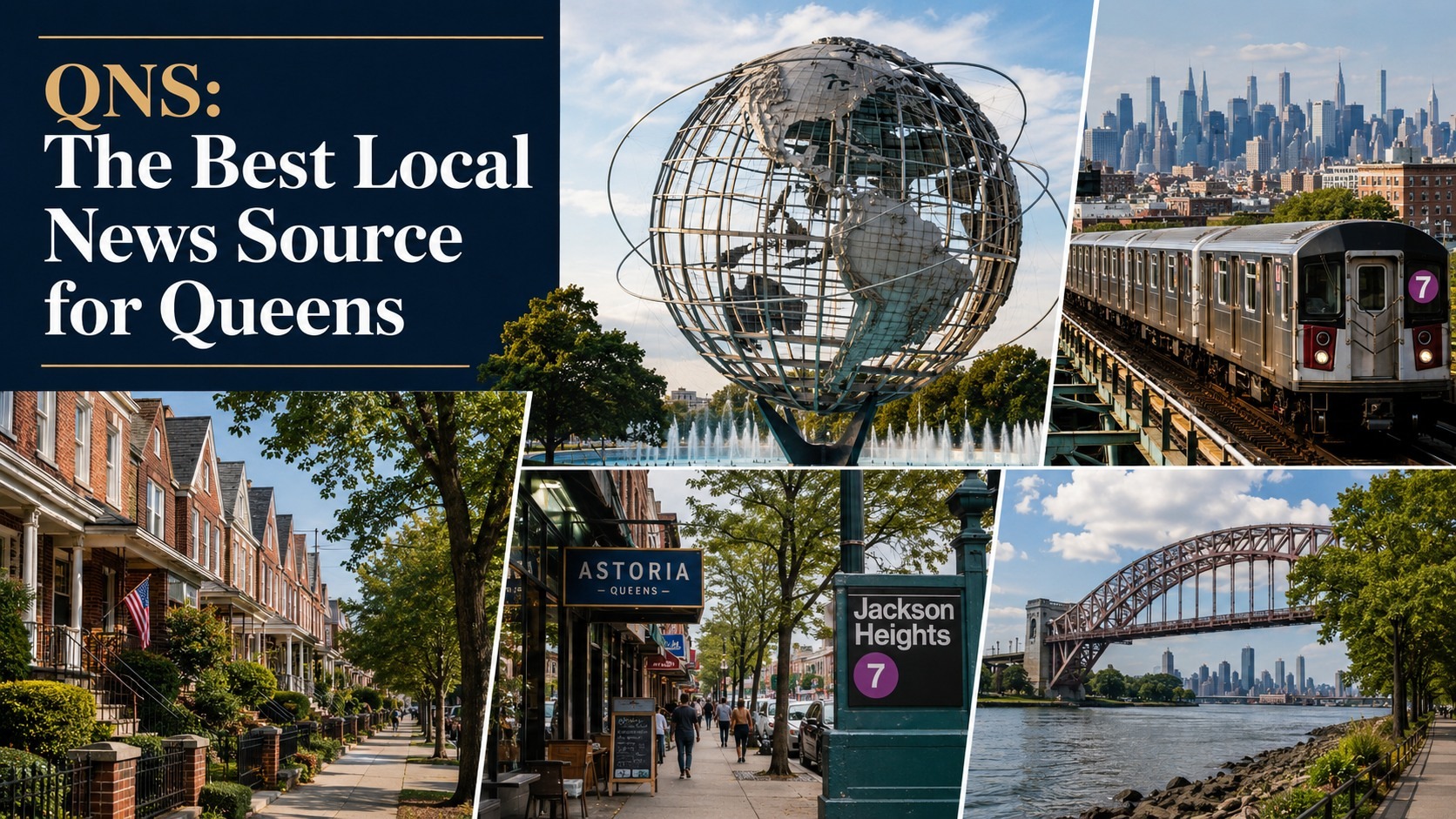

Queens readers need less noise, not more news. That’s why QNS has become one of the more useful local news stops for people trying to understand what’s actually happening across Queens without waiting for a citywide outlet to decide a borough story is big enough. The site isn’t perfect, and it shouldn’t be treated like the only tab you ever need. But for neighborhood-level updates, civic news, food openings, police items, school stories, real estate shifts, transit headaches, and weekend events, it covers a kind of daily Queens reality that bigger New York outlets often flatten.
Queens is too large, too varied, and too restless for one neat news feed. Astoria does not read like Far Rockaway. Flushing does not move like Ridgewood. Jamaica has a different civic temperature from Long Island City. That’s the whole problem. A reader needs a source that treats Queens as a borough made of neighborhoods, not as one big place east of Manhattan.
The Plain Answer
QNS is one of the best local news sources for Queens because it focuses on neighborhood-level reporting, borough politics, events, public safety, dining, real estate, and transportation in one place. It works best as a daily Queens news hub, especially when paired with citywide sources for larger context.
Queens Is Too Complicated for Generic Local News
Queens punishes lazy coverage.
A citywide headline can say “Queens residents react,” and anyone who knows the borough should immediately ask: which residents? Where? Along Northern Boulevard? Near Jamaica Center? In Bayside? On the Rockaway Peninsula? Around Roosevelt Avenue? Those are different civic worlds, and they don’t all care about the same thing on the same morning.
That’s the first reason a Queens-focused outlet matters. New York State describes Queens as the easternmost and largest borough by area in New York City, with a 2023 population listed at 2,252,196 and dozens of distinct neighborhoods. It also notes that residents often identify closely with their neighborhood rather than the borough as a whole.
That last part is not trivia. It explains why local news here has to be granular. A zoning fight in Long Island City may be an abstract development story to someone in Midtown, but to a Queens reader it can mean school crowding, blocked views, construction noise, subway pressure, small business turnover, and the slow rewrite of a block.
And then there’s language. Culture. Transit geography. Airport traffic. Beach politics. Small landlords. Immigrant-owned storefronts. School districts that don’t line up neatly with how people talk about their neighborhoods. Queens local news is not one beat. It’s several beats arguing with each other before lunch.
That’s where Queens local coverage from New York News Ledger can help readers who want a broader independent view, while QNS gives them a steady neighborhood-first feed.
A pattern I keep seeing with Queens readers is simple: they don’t only want breaking news. They want orientation. They want to know if a street closure is part of a larger project, if a new development has a public hearing behind it, if a restaurant opening is actually worth caring about, and if a crime story is being reported with enough detail to avoid panic.
National sites can’t do that well. Most citywide outlets only do it when the story has already become loud.
What QNS Gets Right
QNS works because it understands that borough news is not only crime, politics, and scandal.
The site’s own navigation shows a wide mix of Queens coverage areas, including airport, business, dining and nightlife, entertainment, health, kids and education, police and fire, real estate, sports, things to do, and transportation. Its neighborhood menu also breaks out places like Astoria, Bayside, Corona, Far Rockaway, Flushing, Forest Hills, Jackson Heights, Jamaica, Long Island City, Maspeth, Ridgewood, and Sunnyside.
That range matters. A local outlet that only covers arrests and elections ends up making a borough feel smaller and harsher than it is. Queens has problems, yes. It also has school fundraisers, business openings, street fairs, sports achievements, tenant disputes, airport labor issues, religious events, film shoots, rezoning arguments, and quiet civic meetings where tomorrow’s bigger fight gets its first sentence.
QNS is useful because it puts those ordinary-but-important updates in the same ecosystem.
The ownership and network piece also matters, though readers should understand it clearly. Schneps Media describes QNS as the online home for Queens locals and says it is powered by journalists from Queens Courier, TimesLedger, Courier Sun, Ridgewood Times, Times Newsweekly, BORO, and LIC Magazines. That gives QNS an advantage: it isn’t trying to invent Queens coverage from scratch.
You can see the benefit in the daily mix. A sports item may sit near a police update. A restaurant piece may sit near a City Hall story. A neighborhood profile may show up beside a development article. It feels uneven sometimes, but Queens itself is uneven. That’s not a flaw by default.
The better question is whether the site helps readers act. Can you find the event? Can you understand the agency involved? Can you learn which neighborhood is affected? Can you spot the public official, school, precinct, community board, nonprofit, or business tied to the story?
Often, yes.
Not always. But often enough that QNS earns a place in the Queens reader’s daily rotation.
Is QNS Better Than Citywide News for Queens Readers?
Yes, for neighborhood discovery. No, not for every kind of accountability reporting.
That’s the honest answer, and it saves everyone a lot of fake certainty. QNS is better than most citywide outlets when your question is, “What’s happening around Queens today?” It’s not always better when your question is, “Who has the deepest investigation into the agency behind this mess?”
Those are different jobs.
A citywide outlet has more incentive to chase stories with broad political impact. Think MTA fights, mayoral decisions, NYPD policy, migrant shelter debates, housing mandates, major court cases, or city budget battles. A Queens outlet has more incentive to explain how those decisions land in Flushing, Astoria, Jamaica, Jackson Heights, Forest Hills, Bayside, the Rockaways, and everywhere in between.
The sweet spot is when you use both.
For example, if a transit story involves subway service, bus redesigns, congestion around bridges, or airport access, a citywide outlet may give you the policy frame. QNS may give you the neighborhood temperature. Who’s angry? Which corridor is affected? Which local business district is watching it closely? Which elected official has turned it into a talking point?
That second layer is where local news earns its keep.
The mistake is expecting one outlet to be everything. Readers get annoyed when a local story doesn’t have enough investigative bite. Fair. But they also underrate the boring daily labor of showing up to smaller items: school awards, civic meetings, police briefings, cultural events, and openings that won’t trend anywhere.
Boring is not useless. Sometimes boring is the record.
How QNS Compares With Other Queens News Options
A Queens reader usually needs more than one source. Not because QNS fails, but because no single outlet can cover a borough this large with equal force in every category.
| Source type | Best use | Where it can fall short |
|---|---|---|
| QNS | Daily Queens news, neighborhood updates, events, dining, business, schools, police, real estate, transportation | Not every story gets deep investigative context |
| Citywide NYC outlets | Big policy stories, mayoral politics, NYPD/MTA issues, courts, budget fights | Queens details can get compressed or treated as secondary |
| Hyperlocal blogs and neighborhood groups | Block-level tips, rumors, closures, lost-and-found style updates | Verification can be weak, and context is often missing |
| Official city and borough sources | Public notices, agency statements, meeting details, service updates | They tell you what government wants published, not always what residents need asked |
| Social media accounts | Fast alerts, photos, crowd reaction, event buzz | Speed often beats accuracy, and old posts can recirculate |
The table points to a practical reading habit: use QNS for borough rhythm, then cross-check when the issue has legal, financial, public safety, or political stakes.
That might sound like homework. It isn’t.
It’s the same thing smart readers already do without naming it. You hear about a fire on social media, check a local outlet for confirmed details, check a city agency for service changes, and maybe check a citywide outlet if the story grows. That chain protects you from two bad outcomes: missing something important or believing something too early.
QNS’s advantage is that it gives you a home base. It’s not only a headline stream. It’s organized around how Queens readers search: neighborhood, topic, event, public issue, and daily update.
The part I’d watch closely, as with any local outlet tied to a large media network, is balance. Does the coverage keep enough distance from advertisers, elected officials, business boosters, and institutions that like friendly press? Local journalism lives close to the people it covers. That closeness can create access. It can also create softness.
Both things can be true. Annoying, but true.
What Most People Get Wrong About Queens News
People talk about local news like it’s either heroic watchdog work or fluffy community filler. That split drives me nuts.
Queens needs both the hard stuff and the small stuff. A corruption story matters. So does a school rezoning meeting that only 70 parents understand until it changes a commute. A restaurant closure matters less than a housing lawsuit, sure, but it still tells you what’s happening to commercial rents, foot traffic, and neighborhood identity.
Bad advice usually tells readers to “follow trusted sources” and leaves it there. Fine. Which trusted sources? For what? On what topic? With what blind spots?
A Queens voter trying to understand a borough president race needs different reading than a parent tracking school changes in District 30. A renter in Sunnyside does not need the same feed as a small business owner in Flushing. A Rockaway resident watching coastal projects has a different news diet from someone tracking Long Island City towers.
This is where QNS is useful, but not magical.
Its neighborhood and topic structure lets you browse Queens in slices. That matters because most readers don’t arrive with a clean question. They arrive with a feeling: something is changing near me, and I need to know what it is.
Here’s the tangent, since it belongs here: Queens also suffers from being treated like a food-tour backdrop by people who want dumplings, dosa, tacos, and Greek pastries without caring much about street vendors, language access, delivery workers, immigration enforcement fears, sanitation rules, or commercial lease pressure…but that’s a different article.
Back to the point.
Local news is not only about knowing what happened. It’s about knowing what category of thing happened. Is this a one-off crime story, a recurring public safety pattern, a political performance, a development signal, or a quality-of-life issue that nobody at City Hall wants to own?
The better local outlets help you sort that out. The weaker ones only add noise.
The Downsides Nobody Should Ignore
QNS has clear value, but readers should keep a few trade-offs in mind.
First, local news sites often rely on a mix of staff reporting, contributor work, press releases, event listings, sponsored material, and network content. That does not make them bad. It does mean you should read with a little friction in your brain. Ask who benefits from the story. Ask whether the piece includes more than one side. Ask whether a public official’s statement is being checked or simply repeated.
Second, borough coverage can be uneven. Some neighborhoods naturally produce more headlines because they have more development, nightlife, elected-official attention, major transit nodes, or business activity. Long Island City and Astoria often attract more media attention than quieter eastern Queens communities. Flushing gets attention, but not always with the cultural or language depth it deserves. The Rockaways can disappear from the general conversation until weather, beaches, housing, or tragedy forces attention.
Third, speed can flatten stories. A fast update about an arrest, crash, fire, lawsuit, restaurant opening, or school issue may answer the first question but not the second or third. What happened? You may get that. Why does it matter beyond today? Sometimes you have to wait.
Fourth, local advertising pressure is real across the industry. Neighborhood outlets need revenue, and local businesses need visibility. That relationship can be useful when it helps residents find services, events, and openings. It gets murkier when promotional energy and editorial judgment start wearing the same jacket.
This is not a QNS-only criticism. It’s a local media problem.
The reader’s job is not to become cynical. Cynicism is lazy in its own way. The better habit is to separate story types. A weekend event preview doesn’t need the same skepticism as a development article. A police item should be read differently from a restaurant profile. A sponsored-looking business feature should not carry the same weight as independent reporting.
One small test: does the article tell you what happened, who is affected, where it happened, and what comes next? If it doesn’t, keep reading elsewhere.
Use It Smarter
A good local source becomes much better when you know how to read it. Don’t treat QNS like a magic answer machine. Treat it like a Queens dashboard with some strong gauges and a few blind spots.
- Start with your neighborhood, not the homepage. Check Astoria, Flushing, Jamaica, Long Island City, Forest Hills, Jackson Heights, Ridgewood, Sunnyside, or whichever area actually affects your day.
- Scan by topic when the issue is bigger than one block. Transportation, education, real estate, police and fire, dining, and business stories often connect across neighborhoods.
- Check dates before sharing anything. Local stories age strangely. A road closure, event, arrest update, or hearing notice can become stale fast.
- Look for named sources. Agencies, elected officials, community boards, schools, police, business owners, and residents should be identified where possible.
- Cross-check high-stakes stories. For housing, crime, lawsuits, elections, public health, and major public spending, compare QNS with citywide outlets or official records.
- Use event listings for planning, not proof. Event pages are helpful, but schedules change. Confirm with the organizer when timing matters.
- Watch what gets repeated. If the same theme keeps showing up—rezoning, school crowding, traffic danger, business turnover—that’s usually more important than one loud headline.
That checklist is simple because it should be. Readers don’t need a newsroom degree. They need a repeatable way to avoid being fooled by speed, outrage, or vague community buzz.
The reader habit I like best is the two-tab method. Keep one tab for QNS or another Queens-first source. Keep one tab for a broader NYC outlet or official agency page. When both point in the same direction, you probably have the shape of the story.
Not perfect. Better.
Three Queens Tests
A useful Queens news source has to pass three tests.
The first is the neighborhood test. Does it understand that Queens is not one mood? A site covering Queens should not make Bayside, Corona, Astoria, Elmhurst, Jamaica, Flushing, Howard Beach, and Far Rockaway feel interchangeable. Even short articles should carry some sense of place.
The second is the daily-life test. Does it cover things residents can use? That means events, transit changes, school updates, small business news, food, housing, public safety, and civic deadlines. A local source that only chases drama misses how people actually live.
The third is the follow-through test. Does it return to stories after the first headline? This is the hardest one. Local outlets are stretched. Reporters move fast. Editors make brutal choices. Still, follow-through is where trust grows. A proposal becomes a vote. A vote becomes construction. A lawsuit becomes a settlement. A complaint becomes a policy tweak. Or nothing happens, which is also news if residents were promised action.
QNS passes the first two tests more clearly than the third. That’s my read.
Its structure and topic range show real Queens attention. Its daily usefulness is obvious. The follow-through question depends on the story, and that’s where readers should stay alert. If a major issue appears once and then vanishes, don’t assume it ended. Search again. Check city records. Look for community board minutes. See if another outlet picked it up.
This is where local readers have more power than they think. The questions people ask, share, and push back on can shape what editors decide deserves another pass.
FAQ
Is QNS a reliable source for Queens news?
Yes, QNS is a useful and generally reliable source for daily Queens news, especially neighborhood updates, events, local politics, business, dining, real estate, and public safety. For serious legal, health, crime, or money-related stories, smart readers should still compare coverage with official sources or citywide reporting.
Is QNS only about breaking news?
No, QNS covers more than breaking news. Its site includes categories for neighborhood stories, business, dining, entertainment, education, police and fire, real estate, sports, transportation, and things to do. That mix makes it more useful as a daily borough guide than a breaking-news-only feed.
What neighborhoods does QNS cover in Queens?
Several major Queens neighborhoods appear in QNS navigation, including Astoria, Bayside, Corona, Far Rockaway, Flushing, Forest Hills, Jackson Heights, Jamaica, Long Island City, Maspeth, Ridgewood, and Sunnyside. Coverage may still vary by news volume, reporter access, and what’s happening locally.
Can I use QNS for Queens events?
Honestly, it depends on what you need. QNS is helpful for finding local events and things to do, but event details can change quickly. Use it for discovery, then confirm time, location, ticket rules, and cancellation updates with the event organizer before making plans.
Who owns QNS?
Schneps Media operates QNS, and the company describes it as part of a broader network of local New York media brands. That network gives QNS reach and resources, but readers should still pay attention to story type, sourcing, and whether coverage is editorial or promotional.
Why not just read bigger NYC news sites?
Bigger NYC news sites are useful, but they often focus on stories with citywide impact. Queens readers also need neighborhood-level updates that may never become major city headlines. QNS is better for that local rhythm, while citywide outlets are better for broader policy context.
Does QNS cover Queens politics?
QNS does cover Queens politics, especially local campaigns, elected officials, civic issues, public meetings, and borough-level government stories. The useful move is to read those pieces alongside citywide political coverage, because Queens politics often connects to City Hall, Albany, and agency decisions.
Is QNS the best local news source for Queens?
Best is a little slippery. QNS is one of the strongest Queens-focused daily sources because it combines neighborhood coverage, events, public safety, business, dining, and civic news. It shouldn’t be your only source, but it deserves a regular place in a Queens news routine.
A Better Way to Read Queens
The best Queens news habit is not loyalty to one outlet. It’s knowing which source answers which question. QNS is strong because it gives readers a steady borough feed with enough neighborhood detail to make daily life feel legible. Use it to spot what’s happening, what’s changing, and what people nearby are talking about.
Then do one concrete thing today: search your own neighborhood on QNS and read three recent stories, not just the newest headline. Look for patterns. Transit? Development? Schools? Business turnover? Public safety? That pattern will tell you more than one dramatic story ever could.
Queens doesn’t reward passive readers. The borough is too big, too layered, and too quick to be understood through headlines alone. Good local news gives you the trail. You still have to follow it.