
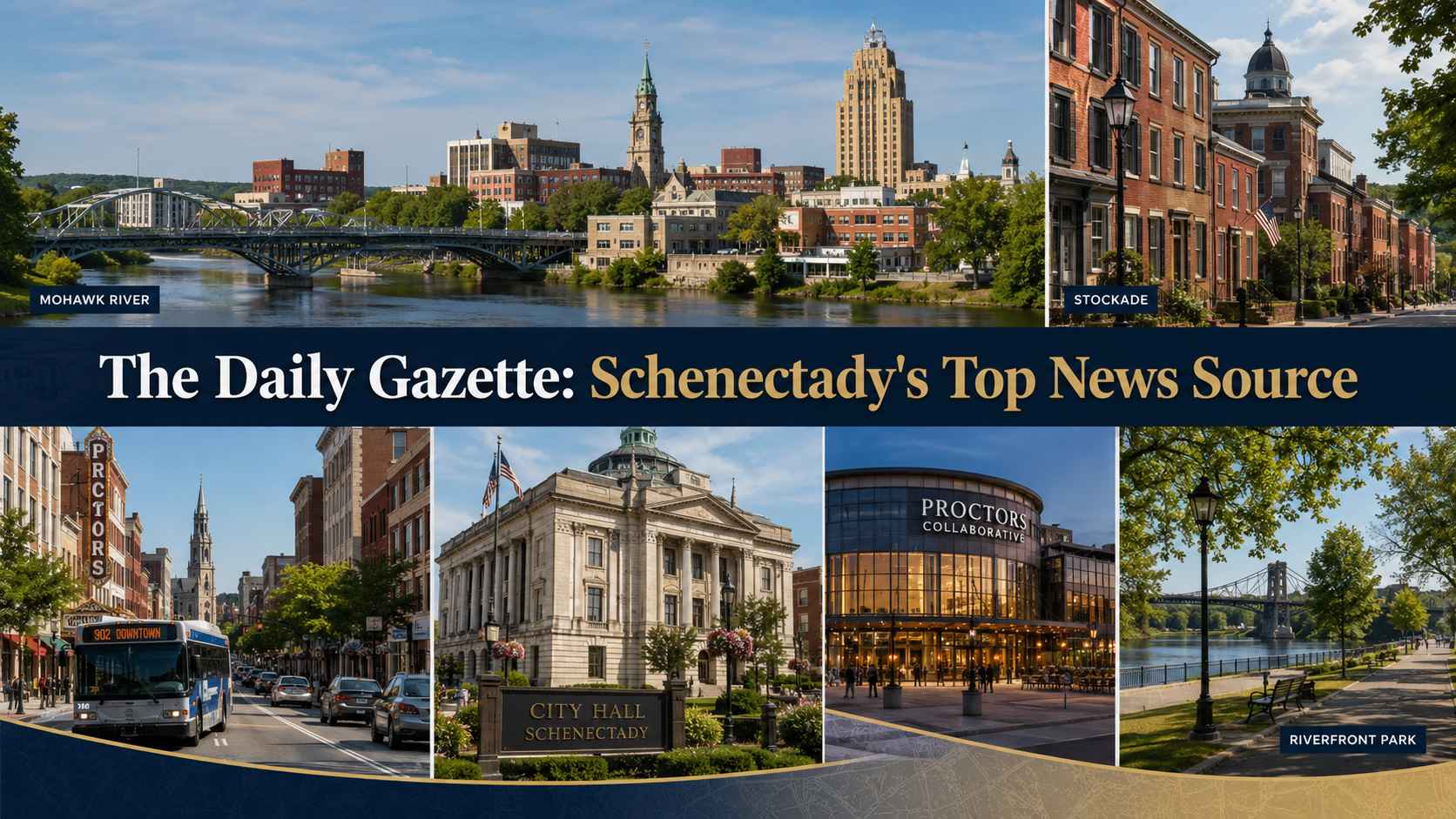

A national headline may explain what happened in Washington, but it usually can’t tell you why a Schenectady school proposal stalled, which road project will reshape your commute, or how a city budget decision could reach your block. The Daily Gazette has built its identity around that smaller, harder, more useful scale.
For readers in Schenectady and the wider Capital Region, the paper serves as a daily record, a watchdog, a sports desk, a community bulletin, and a place where local arguments become visible. It isn’t the only news source available, and it shouldn’t be treated as one. Still, its long history, local reporting base, and mix of print and digital coverage give it a role that social feeds and statewide outlets rarely replace.
This matters because local information is often practical before it is dramatic. You may need a storm update, election context, court coverage, a school board decision, or a clear account of what changed downtown. That’s where a hometown newspaper earns attention: not by shouting the loudest, but by showing up again tomorrow.
Why It Remains a Go-To Source
The Daily Gazette is a Schenectady-based newspaper that reports on local government, public safety, schools, business, sports, culture, and community life across the Capital Region. Its value comes from continuity: reporters follow local stories over time, giving readers context that breaking-news posts often miss.
Local Reporting Matters
A city can look simple from a distance. There’s a mayor, a council, a school district, a police department, a downtown, and a set of neighborhoods. Yet the decisions that shape daily life are usually buried in meeting agendas, budget documents, zoning requests, court filings, labor talks, and public hearings. Someone has to read that material before it becomes understandable news.
That’s the unglamorous strength of a local newspaper. It connects a decision to the people who will feel it. A proposed development isn’t only a rendering and a press release; it can involve traffic, tax incentives, housing demand, neighborhood concerns, construction jobs, and years of follow-through. A school budget isn’t only a total dollar figure; it can affect class sizes, programs, staffing, and property owners.
The paper traces its roots to 1894, and its modern reach includes print and digital formats across Schenectady and other Capital Region counties. Its own app description identifies Schenectady, Saratoga, Fulton, Montgomery, Schoharie, and Warren among the areas it covers. Longevity alone doesn’t prove quality, but it does create an archive of civic memory. Reporters and editors can recognize when a “new” proposal is actually the third version of an old idea.
I’ve noticed that readers often underestimate this memory until a local controversy gets complicated. Then they want to know who voted for the earlier plan, what was promised, which deadline moved, and why the numbers changed. A newsroom that has followed the issue for years starts with a better map.
You can find ongoing Schenectady coverage through the Schenectady local news section, which is useful for readers who want a broader mix of area reporting. The Gazette’s distinct advantage is its day-to-day institutional focus. It keeps returning to the same local bodies, even after public attention drifts elsewhere.
The Schenectady Lens Is the Real Difference
The Gazette’s strongest identity isn’t “New York news.” It’s Schenectady news viewed as part of a connected Capital Region. That distinction sounds small, but it changes what gets covered and how the story is framed.
A statewide outlet may report a major economic announcement because the dollar amount is large. A Schenectady-centered newsroom is more likely to keep asking what the project means for a specific corridor, neighborhood, employer, tax base, or public service. The second question is often more useful than the first.
Look at the range of institutions that can generate important local stories: Schenectady City Hall, the county legislature, the school district, Union College, SUNY Schenectady, neighborhood groups, local courts, police and fire departments, Proctors, small businesses, large employers, and nonprofit organizations. Each operates on its own calendar. Their decisions overlap in ways that don’t fit neatly into one beat.
That’s why local coverage can feel almost oddly specific. A short article about parking rules, a water project, a property sale, or a route change may matter more to one reader than the day’s biggest national story. Useful news is personal in that way. Not private, but close.
The pattern I see is simple: people say they want “the big stories,” yet they repeatedly search for the small details that change plans. Is the meeting tonight? Which streets are affected? Did the board approve the proposal or only schedule a vote? What does the new rule cover? Those questions reward reporting that stays near the ground.
And proximity adds accountability. Public officials know a local reporter may be at the next meeting too. That doesn’t guarantee aggressive coverage, but it changes the relationship. The story is less likely to be a one-day encounter between strangers.
Coverage That Follows the Community
Good local reporting doesn’t divide life into tidy boxes because residents don’t live that way. A housing story can become a school enrollment story. A police policy can become a city budget story. A downtown project can touch transportation, small business, arts funding, and neighborhood identity before the first construction barrier appears.
The Daily Gazette’s broad local mix is useful for that reason. On a normal reading day, you may move from city government to high school sports, then to a restaurant opening, a court case, an obituary, an editorial, or a weekend event. The variety isn’t random. It reflects how a community actually functions.
Local sports coverage deserves more credit than it gets. Scores are easy to find now, but a box score doesn’t explain a rivalry, a coaching change, a senior class, or why a particular season matters to a school. The same is true of arts coverage. Event listings tell you what’s scheduled; reporting tells you why an institution, performer, venue, or festival matters locally.
The paper also gives residents a shared reference point. People may disagree sharply with an editorial or with the framing of a news story, yet they are at least reacting to a common set of facts. That shared base has become scarce. Social platforms sort people into separate streams, where the loudest post can outrun the most careful one.
There’s another detail worth saying plainly: not every local story will be exciting. Some are procedural. Some involve a board appointment, a contract renewal, or a planning document that won’t produce visible change for months. But the boring meeting on Tuesday can explain the expensive problem everyone notices next year.
Consider a realistic development story. A proposal for a large apartment project may begin with an announcement and a polished image. The useful reporting starts after that: zoning questions, parking estimates, tax arrangements, environmental review, public comments, construction timing, and whether the plan changes before approval. Months later, the most important article may be the one that compares the final agreement with the first promise.
Or take a winter storm. A television alert can tell you snow is coming, while a local report can connect the forecast to Schenectady school closings, parking restrictions, plowing priorities, transit changes, warming centers, and delayed public meetings. None of those details is glamorous. Together, they shape the day.
School coverage works the same way. A budget proposal can arrive as a thick packet filled with categories that mean little to a casual reader. Strong local reporting translates the document into choices: which programs grow, where positions are reduced, what assumptions depend on state aid, and what voters are actually being asked to approve. The vote matters, but the explanation before the vote may matter more.
These examples show why breadth should not be confused with shallowness. A local newsroom needs enough range to recognize connections, then enough patience to stay with a story after the crowd leaves.
A Newspaper With a Memory
Local newspapers are often judged by what they publish today, but their deeper value sits in accumulated attention. A newsroom that has covered Schenectady for generations carries names, disputes, projects, institutions, and turning points forward. Readers may not see that background in every article, yet it shapes which questions get asked.
The Gazette began in 1894 and spent much of the twentieth century under the Schenectady Gazette name before returning to The Daily Gazette. Library records document the Schenectady Gazette title from 1902 through 1989. That history gives the paper a long record of the city’s industrial shifts, political eras, neighborhood changes, cultural milestones, and civic arguments.
Archives are not magic. Old reporting can contain the assumptions and blind spots of its time. Still, an accessible record lets readers compare promises with outcomes. It lets a reporter revisit what officials said before a vote. It helps families trace community events, businesses, schools, and public figures.
And yes, old newspapers are also full of wonderfully strange details: advertisements, phrasing, forgotten clubs, local controversies that once seemed enormous. You could spend hours following how a single street changed across decades, but that’s a different article.
The larger point is continuity. A city without a reliable record becomes easier to rewrite from memory, and memory is selective. I’ve found that the best local reporting often begins with a quiet correction: this issue didn’t start last week, this project had an earlier name, or this debate already produced a compromise that people have forgotten.
That kind of context rarely goes viral. It’s still one of the strongest reasons to keep a local newspaper in your reading mix.
What Most People Get Wrong About Local News
The laziest criticism says local newspapers only repeat press releases. Sometimes they do publish routine announcements, and readers should expect clear labeling and added reporting when a claim needs testing. But reducing the entire job to rewritten statements ignores the work that happens before and after a headline appears.
A reporter may sit through a long meeting to catch a two-minute exchange that changes the meaning of a proposal. They may compare a new budget with last year’s, call several people who don’t respond, check a court record, request a document, and then write a story that takes four minutes to read. The final piece can look simple because the mess has been sorted out.
Another bad assumption is that a local outlet must cover everything to be useful. No newsroom can. The better question is whether it consistently covers the institutions with the greatest public impact, corrects errors, distinguishes news from opinion, and returns to unfinished stories. Coverage depth matters more than the illusion of total coverage.
Some readers also treat any article they dislike as evidence of bias. That’s too easy. A fair evaluation asks harder questions: Are the central facts supported? Were the key parties given a chance to respond? Does the headline match the article? Is context missing in a way that changes the meaning? You can disagree with emphasis without declaring the entire report false.
This is where I get mildly annoyed with “just use social media” advice. Social posts are useful leads, not a dependable replacement for reporting. A neighborhood group may flag a problem before any newsroom does, but posts can mix firsthand information, rumor, old photos, speculation, and frustration in one thread. Verification takes work. Pretending it doesn’t is how small errors become community-wide certainty.
The reverse mistake is trusting a newspaper automatically because it is old. History creates responsibility, not immunity. Readers should notice corrections, sourcing, follow-up, headline tone, and whether opinion is clearly separated from reporting. Loyalty is fine. Blind loyalty isn’t.
A healthy local information system needs both professional reporting and active residents. Tips, public comments, meeting attendance, photos, documents, and direct experience can all sharpen coverage. The newsroom’s job is to test, organize, and explain that material without turning every claim into a headline.
What Does Local News Cost, and What Are the Trade-Offs?
Local journalism costs money because reporting is labor. A story that looks short can require hours of calls, document reading, travel, editing, photography, legal review, page production, web publishing, and follow-up. Advertising once carried more of that burden. Today, subscriptions, memberships, sponsorships, events, and other revenue sources often have to share the load.
For readers, the trade-off is obvious: free information is attractive, but the most useful local reporting may sit behind a subscription limit. Current print offers tied to the Gazette include home-delivery options with digital access, e-editions, and mobile app access, though rates and promotions can change. It’s smarter to check the current terms than to assume an old price still applies.
The downside of a paywall is real. A public-interest report about safety, elections, schools, or an emergency can be harder to reach when access is limited. News organizations have to balance public service with the need to pay staff. Readers, meanwhile, have to decide which outlets are worth supporting.
Here’s the practical test I use: count usefulness, not article volume. Over a month, did the reporting help you understand a local vote, avoid a disruption, follow a school issue, discover an event, evaluate a candidate, or make sense of a public controversy? One deeply useful story can be worth more than dozens of disposable updates.
There are editorial trade-offs too. A regional newsroom can share resources across several communities, which may support specialty reporting and wider reach. But growth can also create pressure to cover more territory with the same attention. The Gazette’s ownership and footprint have changed in recent years: the Hume-Lind family agreed in 2024 to sell the company to longtime publisher John DeAugustine, and the group has continued expanding its regional newspaper holdings.
Expansion isn’t automatically good or bad. The meaningful questions are local: Are reporting positions maintained? Do community-specific beats remain visible? Are stories edited with local knowledge? Does a broader network produce more reporting, or simply more shared content?
Readers should watch outcomes rather than slogans. Ownership matters, but staffing, newsroom independence, beat continuity, corrections, and daily editorial choices tell you more about what a paper is becoming.
How the Gazette Fits Into Your News Mix
No single source should carry your entire understanding of a community. The Gazette can be a central source for Schenectady and Capital Region reporting, but it works best alongside public records, direct government notices, local radio and television, neighborhood reporting, and other newspapers.
The point isn’t to consume more news until you’re exhausted. It’s to assign each source a job. A newspaper is often strongest at continuity, written context, public meetings, enterprise reporting, local sports, and searchable archives. A city website is strongest for official agendas, notices, forms, and documents. A weather service is strongest for alerts and forecasts. A neighborhood group is strong at immediate observation, though verification can be uneven.
| Source type | Best use | Main strength | Common weakness |
|---|---|---|---|
| The Daily Gazette | Ongoing Schenectady and Capital Region coverage | Context, beat reporting, follow-up, local archive | Some access may require a subscription |
| City or county websites | Agendas, minutes, notices, public documents | Primary official information | Often lacks plain-language explanation or outside scrutiny |
| Local TV and radio | Breaking news, live updates, weather, traffic | Speed and visual or audio reporting | Short segments can leave little room for detail |
| Social media and neighborhood groups | Tips, eyewitness posts, community reaction | Fast local signals and direct participation | Rumor, missing context, and recycled information |
| Regional or statewide outlets | Bigger political, economic, and policy context | Wider comparison across New York | Less attention to small Schenectady developments |
The table shows why “Which source is best?” is usually the wrong question. The better question is “Best for what?” When a water main breaks, speed matters. When a school board adopts a complicated budget, detail matters. When a development deal includes public money, documents and follow-up matter.
I’ve noticed that well-informed local readers often use a simple sequence without naming it. They hear about an issue on social media, read a reported article for context, check the public document, then watch what happens next. Each source corrects a weakness in the others.
The Gazette’s official website is the natural starting point for its current reporting, digital features, and publication offerings. According to the paper’s app listings, its digital service is designed to deliver Capital Region news in both print-connected and mobile formats. That flexibility matters because news habits are no longer tied to a doorstep or a single morning edition.
Still, convenience can distort attention. Push alerts favor urgency. Homepages favor what is new. Social feeds favor reaction. Some of the most important local stories develop slowly and never produce a dramatic alert. You have to choose to follow them.
A Smarter Way to Read It
Reading local news well is a skill. Scrolling headlines gives you awareness, but it doesn’t always give you understanding. A better routine is selective, repeatable, and skeptical without becoming cynical.
- Start with the local homepage or Schenectady coverage. Scan for government, schools, public safety, development, transportation, courts, and community issues that affect your area. Don’t read everything; identify what has consequences.
- Open the full story before reacting to the headline. Headlines compress. The article should tell you what happened, what remains uncertain, and where the information came from. If it doesn’t, that gap is worth noticing.
- Check the date and update time. Breaking stories can change quickly. An early report may be accurate but incomplete, especially during emergencies, police investigations, election counts, or severe weather.
- Separate reported facts from opinion. News stories, editorials, columns, letters, and sponsored material serve different purposes. Read them differently. Strong opinions are not a problem when they are clearly labeled.
- Follow the issue, not only the event. Save or revisit stories about budgets, construction, school plans, major court cases, and public projects. The first announcement is rarely the whole story.
- Compare important claims with primary records. For a major vote, look at the agenda, resolution, budget, court filing, or official notice when it is available. The article provides meaning; the document provides the underlying record.
- Support or challenge the coverage constructively. Send a tip, ask a specific question, point out a possible error, or share a relevant document. A useful correction is more valuable than a vague accusation.
This routine takes less time than endless scrolling because it gives your attention a purpose. You stop treating every headline as equally important.
And you’ll notice something else: follow-up reporting becomes easier to value. A second or third story may not feel as exciting as the first alert, but it often contains the answer readers actually needed. Was the plan approved? Did the cost rise? Did the promised timeline hold? Did anyone change position?
That’s the pattern popular news advice misses. Staying informed isn’t mainly about reading faster. It’s about remembering enough to recognize what changed.
How Can You Tell When Local Coverage Is Doing Its Job?
Trust shouldn’t be a mood. You can evaluate a local news outlet by looking for repeatable signs in its work.
Start with sourcing. A strong report tells you where key information came from: a public meeting, named official, document, court record, interview, data release, or direct observation. Anonymous sourcing may sometimes be needed, but it should not become a shortcut for claims that could be supported openly.
Next, examine the difference between certainty and uncertainty. Good reporting is comfortable saying that a fact is not yet known. Early information changes. Estimates get revised. Investigations remain open. A careful article marks those limits instead of filling gaps with confident language.
Corrections matter too. No newsroom avoids every error. The important question is whether mistakes are corrected clearly and promptly. A correction should help the reader understand what changed, not hide the repair behind vague wording.
Then look for follow-through. Did the outlet return after the press conference? Did it examine the final agreement, not only the announcement? Did it ask whether a program met its goal? Did it cover the quiet implementation stage after public interest faded?
This is where local papers can earn or lose trust over time. One impressive investigation doesn’t excuse months of thin reporting, and one weak story doesn’t erase years of solid work. Patterns are more revealing than isolated examples.
I also watch for whose voices appear. Officials are necessary sources, but they are not the whole community. Residents, workers, business owners, students, parents, experts, advocates, and people directly affected can expose consequences that official statements overlook. Balance doesn’t mean placing two quotes against each other and calling the work finished. It means reporting the issue at the scale where people experience it.
Does the headline match the evidence? That question catches more problems than broad arguments about bias. A dramatic headline paired with a cautious article can mislead even when every sentence below is technically accurate.
Finally, ask whether the coverage helps you understand what happens next. Deadlines, meeting dates, appeal options, public comment periods, expected votes, and unresolved questions turn news into usable information. A reader should leave with a clearer picture, not only a stronger emotion.
Frequently Asked Questions
Is The Daily Gazette based in Schenectady?
Yes, The Daily Gazette is based in Schenectady and has long treated the city as the center of its identity. Its reporting also reaches other communities across the Capital Region, so readers will see both city-specific coverage and regional stories that affect nearby counties.
How old is The Daily Gazette newspaper?
130-plus years. The newspaper traces its beginning to 1894, though its name and publishing operation have changed over time. Its long run gives Schenectady a substantial newspaper archive and gives current reporters historical context for recurring local issues.
Can I read The Daily Gazette online without getting the print paper?
Digital access is available through the newspaper’s website, app, and e-edition offerings. Exact subscription terms can change, so check the current options before signing up. Print packages may also include digital access, which is useful for households that want both formats.
Does The Daily Gazette only cover Schenectady?
No, its coverage extends beyond Schenectady into other parts of the Capital Region and nearby counties. Schenectady remains central to the paper’s identity, but regional government, business, sports, public safety, and community stories are also part of the publication’s regular scope.
Is local newspaper reporting more reliable than social media?
Often, reported newspaper coverage is more dependable because journalists are expected to verify information, identify sources, seek responses, and correct errors. That doesn’t make every article perfect. Social media can surface news quickly, but a fast post and a verified report are not the same thing.
Why do some Daily Gazette articles require a subscription?
Honestly, it depends on the paper’s current access rules and the type of content. Subscriptions help pay for reporters, editors, photographers, publishing systems, and local coverage. The trade-off is that some public-interest information may be less accessible to non-subscribers.
Who owns The Daily Gazette now?
The company moved from long-term Hume-Lind family ownership to publisher John DeAugustine following the 2024 sale process. Since then, the newspaper group has continued expanding its regional holdings, making staffing and local editorial attention important measures for readers to watch.
What kinds of Schenectady stories should I follow regularly?
City government, county decisions, school district news, public safety, development, housing, transportation, local business, courts, and community institutions deserve regular attention. The most useful stories are often ongoing issues where costs, deadlines, votes, or public promises change over time.
The Value of Showing Up
Local news earns trust through repetition, not reputation alone. The strongest reason to read a Schenectady newspaper is that the city keeps changing in small decisions long before those changes become obvious. A reliable local outlet helps you see the process, the people involved, and the unanswered questions.
The Daily Gazette remains important because it combines a long civic record with current reporting across print and digital formats. It should be read thoughtfully, compared when the stakes are high, and judged by its sourcing, corrections, follow-up, and local depth.
Today, choose one Schenectady issue that affects your life and follow it past the first headline. Read the latest report, check the underlying public information, and return after the next vote or deadline. That habit will teach you more about your community than a month of random scrolling.
The best local journalism doesn’t merely tell you what happened. It remembers enough to ask what changed.