
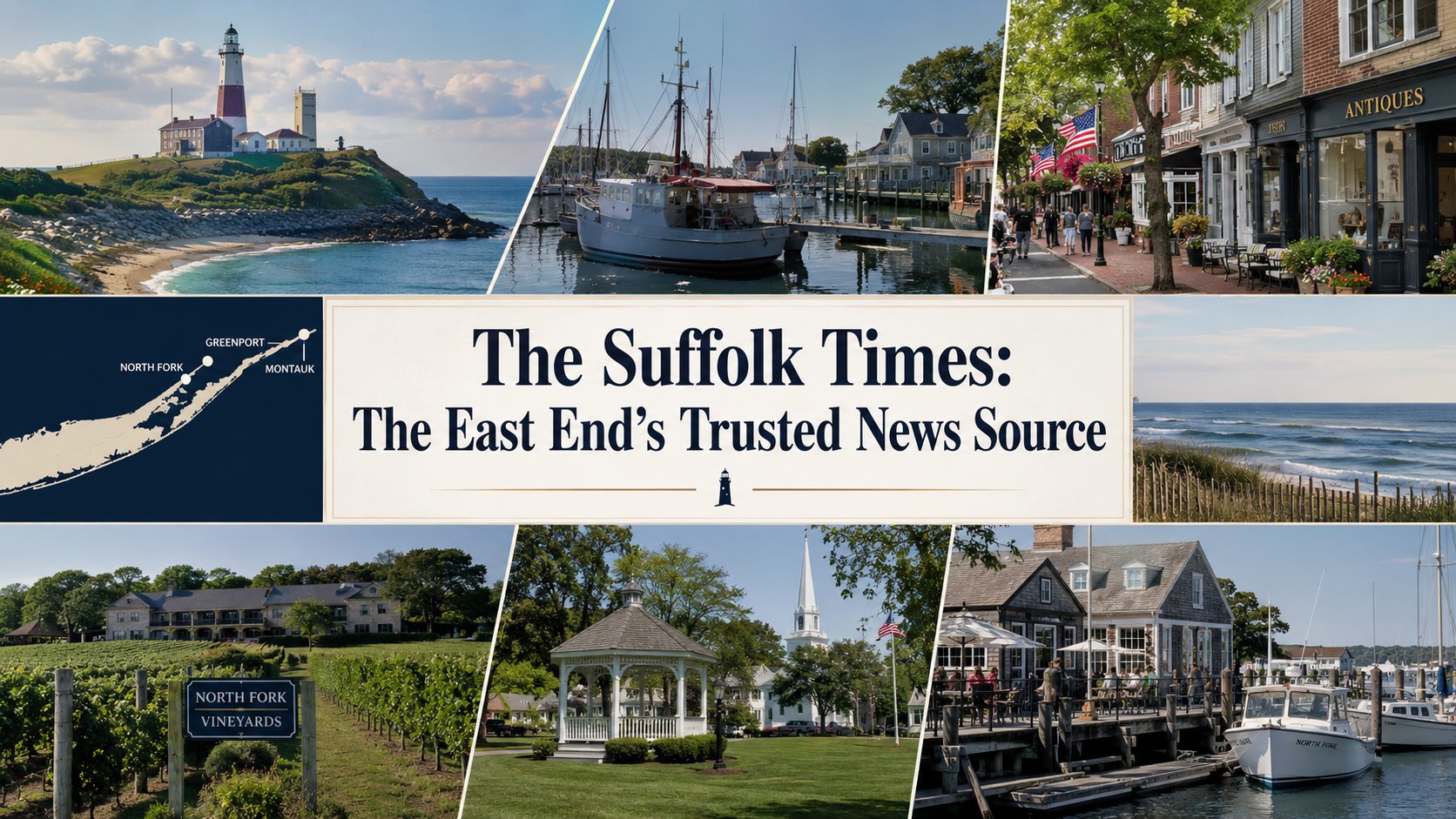

Is one weekly paper still enough for the East End? Halfway, yes: The Suffolk Times still gives North Fork readers the kind of local reporting that bigger outlets usually skim, especially when the story sits in Southold, Greenport, Mattituck, Cutchogue, Peconic, or the farm-and-water edge of Suffolk County.
That matters because East End news can get oddly distorted. Manhattan media notices the beaches. Regional TV notices storms, crashes, and summer traffic. Countywide outlets notice politics when the fight gets loud enough. But day-to-day North Fork life runs on smaller signals: a zoning change, a ferry backup, a school board vote, a police blotter item, a farm issue, an obituary everyone quietly reads.
The Suffolk Times has an old-fashioned job in a newer media world. It has to cover the local basics, keep its archive useful, publish fast enough online, and still feel like a paper that understands the towns it serves. That mix is why people keep searching for it, not because they need another generic Long Island news page.
The plain answer
The Suffolk Times is a trusted East End news source because it focuses tightly on the North Fork, covers community news that larger outlets often miss, and belongs to a local media group built around regional papers and magazines. It’s best for Southold-area news, civic updates, local sports, police reports, obituaries, and North Fork community coverage.
North Fork Specifics
A good local paper doesn’t win because it has the loudest headlines. It wins because it knows which quiet items will matter three weeks later.
That’s the real strength of The Suffolk Times. Its coverage sits close to the small-government layer of the East End: town boards, village meetings, school communities, police updates, local sports, arts, business changes, and those quality-of-life stories that sound minor until you live near them. The official site presents itself as “the premier news outlet covering the North Fork,” and its current navigation shows the practical mix readers expect: news, sports, police, events, obituaries, real estate, classifieds, an e-paper, and subscription access.
For a reader in Southold or Greenport, that mix isn’t decorative. It’s the point. You may not read every zoning story, but when a project appears near your road, you suddenly care about the last five meetings. You may skip the sports page until a niece, neighbor, or former student gets named. You may ignore classifieds until you need a local rental, a service provider, or a small notice that never shows up in a national search.
This is where a North Fork news source earns its keep. It remembers that a local story is not small to the people inside it.
Bigger outlets tend to flatten the East End into a lifestyle postcard. Wine. Beaches. Real estate. Summer people. Traffic. Done. The Suffolk Times has to deal with the rest of it: ferry lines, school budgets, farm pressures, village disputes, volunteer groups, local losses, and local wins that don’t need cinematic treatment.
And honestly, that’s more useful.
Why readers trust a smaller East End paper
Trust in local news is rarely built by one huge investigation. It’s built by a boring pattern of showing up.
The Suffolk Times benefits from that pattern. Times Review Media Group describes the paper as covering the North Fork since 1857, which gives it a long institutional memory in a region where memory matters. A publication with that kind of history has seen the East End move through farming shifts, housing pressure, tourism growth, school changes, ferry debates, preservation fights, and the slow squeeze that comes when beautiful places become expensive places.
That doesn’t mean every reader agrees with every story. Local readers rarely do. In fact, the angriest readers are sometimes the most loyal ones. They complain because they still expect the paper to get the town right.
There’s a pattern I’ve noticed with local outlets: readers judge them less by polish and more by recognition. Does the story name the right village? Does it understand the road everyone uses? Does it know the difference between a seasonal issue and a year-round problem? Does it treat a school fundraiser with the same basic care as a public hearing?
The Suffolk Times generally works in that lane. It doesn’t need to pretend Southold is Manhattan with nicer sunsets. It needs to understand how North Fork life actually moves.
That’s a narrower job. It’s also harder than outsiders think.
Local credibility can be fragile. One sloppy headline, one missed meeting, one overhyped crime item, one story that makes residents feel talked down to, and people remember. But a paper that keeps covering the same towns over time builds a kind of ledger. Readers may argue with it, but they still check it.
A weekly paper can still beat faster outlets
Speed gets the attention. Local memory does the work.
That sounds backward because online news has trained people to treat “first” as the highest virtue. First alert. First tweet. First headline. First shaky detail. But on the East End, first isn’t always best. A rushed post about a town issue can miss the practical stakes: who pays, which neighborhood changes, what the board actually voted on, and whether the fight is new or part of a longer pattern.
The Suffolk Times has to compete with Patch, Newsday, social media groups, public agency notices, and word-of-mouth. That’s a crowded shelf. But its advantage is focus. It doesn’t have to cover all of Long Island with equal force. It can stay closer to the North Fork beat.
You see the difference in story selection. A regional outlet may cover a big weather warning, a high-profile arrest, or a political fight once it becomes countywide. A North Fork paper can cover the smaller lead-up: the farm impact, the road closure, the ferry backup, the school calendar change, the local business strain, the village meeting where everyone was polite until they weren’t.
And that’s usually where the reader’s actual question lives.
Not “what happened on Long Island?” More like: “Will this affect my commute to Greenport?” “Is this project near my home?” “Did the board approve it?” “What’s happening with the school budget?” “Where are the Fourth of July events?” “Who passed away?” “Is the police report online?”
A weekly rhythm can still serve those needs if the website updates enough between print cycles. The Suffolk Times site does publish current online categories and dated items, which matters because readers no longer wait for a paper bundle to know what happened.
Print legacy helps. Online presence keeps it alive.
Where The Suffolk Times fits beside other Long Island news
The Suffolk Times is not trying to be every Long Island outlet at once, and that’s good. It sits in a specific lane: North Fork-first local reporting.
That lane looks different from broader Suffolk County coverage. A countywide outlet usually has to spread attention across Huntington, Smithtown, Islip, Babylon, Brookhaven, Riverhead, the Hamptons, and the East End. Even when the reporting is strong, the space is limited. The North Fork may get attention when a story has regional pull, but smaller civic items often fall through.
For readers comparing outlets, here’s the cleanest way to think about it.
A larger Long Island outlet is useful when you need regional context. A TV station is useful when something urgent or visual happens. A town website is useful for official notices, agendas, and documents. A Facebook group is useful for rumor speed and neighbor chatter, although that comes with a mess attached. The Suffolk Times is useful when you want a reported local version of what’s happening in North Fork communities.
That distinction matters for New York News Ledger readers too. If you’re tracking broader Suffolk County local news coverage, The Suffolk Times is one of the local sources worth understanding because it covers the part of the county that often gets treated as either vacation territory or political afterthought.
Look at the publisher family as well. Times Review Media Group lists The Suffolk Times alongside the Riverhead News-Review, Shelter Island Reporter, Northforker, and Southforker. That tells you the group isn’t built around one random site. It’s a cluster of local and regional publications aimed at eastern Long Island audiences.
That can be a strength. It can also create overlap. But overlap isn’t always waste. On the East End, town lines and reader habits don’t fit into neat boxes.
What most people get wrong about local news
The lazy take is that local papers are “small,” so the work must be simple.
No. That’s backwards.
Local reporting is hard because everyone knows the stakes, the names, and the grudges. You can’t hide behind distance. A story about a national policy fight can float at 30,000 feet. A story about a Southold zoning decision has to land on the right road, the right parcel, the right meeting, and the right quote. Miss one piece and readers will let you know.
This is what people get wrong about The Suffolk Times and papers like it. They judge the outlet by whether the site looks as slick as a national magazine or whether every story feels huge. But the value of a local paper is not glamour. It’s continuity.
Look, some local stories are boring until they’re yours. A school board budget looks dull until your tax bill or child’s program is involved. A police blotter feels routine until it explains the sirens you heard. An obituary page feels old-fashioned until it gives a family the public record they wanted. A small business item seems light until you realize it marks another shift in a town’s commercial life.
The internet made people confuse scale with importance. Bad habit.
The Suffolk Times works because it treats North Fork life as worthy of regular attention. Not just when outsiders arrive. Not just when there’s a scandal. Not just when summer traffic makes everyone cranky.
The best local newsrooms understand something search engines don’t always reward: a community is made of repeat details. Names. Places. Meetings. Seasons. Complaints. Traditions. The same issues coming back with new faces.
That’s not small. That’s the archive of a place.
Costs, limits, and the subscription question
Here’s the part many rosy reviews skip: trusted local news still has costs, limits, and trade-offs.
Readers want local journalism to be free, fast, accurate, and staffed by people who know the area. That combination rarely survives without money. Someone has to attend meetings, edit copy, update the website, handle photos, maintain archives, process obituaries, cover sports, manage subscriptions, and keep the whole operation from turning into a broken link farm.
The Suffolk Times, like many local outlets, uses subscriptions and an e-paper model as part of its reader relationship. Its site navigation points readers toward subscribing and accessing the e-paper, which signals that not everything is built for casual drive-by traffic.
That can annoy readers. I get it. You search for one local item and hit a wall, or you only want one obituary, or you’re used to social media snippets. But the alternative is usually worse: fewer reporters, thinner coverage, more press releases, and a local information gap filled by rumor.
Still, a subscription doesn’t make sense for everyone. A year-round resident who follows Southold Town meetings, school news, police reports, and community events will likely get more value than a casual summer visitor. A business owner, real estate professional, nonprofit organizer, or parent with kids in local schools may find it useful because local details affect decisions. A reader who only wants the occasional big headline may be fine checking free headlines, public notices, or broader Long Island coverage.
The downside of a smaller outlet is also obvious. It can’t cover every issue with the depth readers want. It may miss stories. It may prioritize one town over another during busy weeks. It may not have the staff size to produce long investigations every time a public question deserves one.
But demanding national-scale output from a local newsroom while refusing to pay for it is a neat little fantasy. A popular one, sadly.
The East End has two audiences
There’s the East End people visit. Then there’s the East End people live in.
That split explains a lot about why The Suffolk Times matters. Outsiders often search the North Fork for restaurants, wineries, beaches, farms, weekend rentals, and charming village photos. Year-round readers care about those things too, but they also care about septic systems, school enrollment, ferry schedules, road work, local taxes, storm prep, affordable housing, land preservation, and who is running for town office.
A good North Fork news outlet has to serve the second audience without ignoring the first.
That’s not easy. Tourism coverage brings attention. Real estate brings clicks. Food and lifestyle stories travel well on social media. A public meeting recap usually doesn’t. But the meeting recap may be the more useful piece for residents.
Here’s the tangent, because it’s hard to resist: East End media also has to fight the Instagram version of the region, where every vineyard is golden, every porch is tasteful, and nobody seems to need a plumber, a school bus, or a parking space…but that’s a different article.
The Suffolk Times is strongest when it resists that postcard flattening. The North Fork is beautiful, yes. It’s also a working place with farms, marinas, schools, small businesses, civic pressure, aging infrastructure, and residents who don’t want every story reduced to weekend charm.
That tension shows up again and again in East End coverage. Preservation versus growth. Tourism versus livability. Private property versus community character. Local control versus county or state policy. Seasonal money versus year-round affordability.
A source that understands those tensions can explain a story before it explodes.
Comparing the news options readers actually use
No single source should be your only source. That’s true even for a strong local paper.
The Suffolk Times is useful, but smart readers cross-check local information depending on the issue. If a story involves a government decision, read the article, then look at the agenda or public documents. If it involves weather or emergency alerts, check official agencies. If it involves a rumor moving through Facebook, wait for reporting before treating it as fact. If it involves a business opening, closing, or changing hands, local reporting plus direct business confirmation is cleaner than hearsay.
Here’s a practical comparison.
| Source type | Best for | Watch out for |
|---|---|---|
| The Suffolk Times | North Fork news, Southold-area civic coverage, police items, sports, obituaries, events | Smaller staff capacity and possible paywall limits |
| Countywide Long Island outlets | Regional context, larger investigations, Suffolk County politics | North Fork stories may get less frequent attention |
| Town and village websites | Agendas, minutes, official notices, forms | Plain language is not always their gift |
| Social media groups | Fast chatter, lost pets, road talk, neighborhood tips | Rumors travel like they stole a car |
| TV news | Breaking visuals, weather, major public safety stories | Short segments can miss local nuance |
The table is simple because the decision is simple. Use The Suffolk Times when the question is local and reported. Use official sources when the question is procedural. Use broader media when the issue stretches beyond the North Fork.
The mistake is expecting one outlet to do every job.
I’ve seen readers blame local papers for not being town hall, police dispatch, tourism bureau, historical society, and watchdog group all at once. That’s not a fair model. Better to know what each source does well.
Is The Suffolk Times still worth reading?
Yes, especially if your life, work, family, property, school, or civic attention touches the North Fork.
The Suffolk Times is still worth reading because the North Fork needs coverage that doesn’t treat it as a side note. Search engines are good at finding recent pages. They’re not good at understanding why a town board item from last month matters to a neighborhood this month. Local papers are supposed to keep that thread.
You’ll get the most value if you read it with a specific purpose. Don’t just scroll headlines and decide whether the whole outlet matters. Check the categories that match your life. News for civic issues. Police for public safety snapshots. Sports for school and community pride. Obituaries for local record. Events for weekend planning. Real estate and classifieds if you track the local market or services.
The official Suffolk Times website is the clean place to start because it shows the current mix of categories and recent coverage without relying on reposts or copied snippets. Use the source directly when possible. That saves time and avoids the weird half-information that floats around search results.
No outlet is perfect. Local papers can be uneven. They can be understaffed. They can move slower than rumor. They can publish a story that leaves you wanting three more follow-ups.
But “not perfect” is a weak reason to ignore one of the few sources consistently watching the North Fork.
How to read it without missing the important parts
You’ll get more from The Suffolk Times if you read it like a local intelligence source, not like a magazine you browse once and forget.
Try this checklist:
- Scan the main news page for town, school, ferry, police, and public meeting items before reading softer features.
- Check dates carefully, because local stories can stay relevant long after the first post.
- Read obituaries and community notices if you’re tracking the social fabric of a town, not just hard news.
- Cross-check government decisions with town or village agendas when the issue affects money, land, permits, or public access.
- Save stories about zoning, development, preservation, and school budgets, because those topics often come back in later meetings.
- Compare major East End stories with countywide outlets when the issue reaches beyond Southold or Riverhead.
- Treat social media reactions as leads, not proof, until reported details catch up.
That routine sounds more serious than casual scrolling, but it pays off. Local news becomes useful when you connect stories over time. A one-off article tells you what happened. A pattern tells you where the town is moving.
And patterns are where East End news gets interesting.
You may notice, for example, that the same pressures repeat under different headlines: traffic, tourism, preservation, housing, school funding, waterfront access, farm viability, emergency services, and the cost of keeping small communities livable. The Suffolk Times gives you the pieces. You still have to assemble some of the picture yourself.
That’s not a flaw. That’s reading like an adult.
The best uses for residents, visitors, and local businesses
Different readers need different things from The Suffolk Times.
A year-round resident should use it as a civic habit. Not daily doom-scrolling. More like a steady check-in. What did the town board discuss? Which school issue is heating up? What local events are coming? Did a road, ferry, or public safety item affect the week? Who in the community is being recognized?
A visitor should use it differently. The paper can help you see beyond glossy travel content. If you’re coming to the North Fork, local news gives you a better sense of timing, events, traffic pressure, weather disruptions, business changes, and community expectations. That matters if you don’t want to act like the person locals quietly complain about.
A local business owner should read for weak signals. A policy change, a festival date, a ferry problem, a farm story, or a school calendar item can affect foot traffic and planning. Small businesses don’t need every article. They need the ones that hint at shifts before they become obvious.
A homeowner or buyer should read with extra patience. Real estate headlines alone won’t explain a place. Local coverage can show the civic debates behind property value: development fights, preservation efforts, infrastructure strain, school district concerns, short-term rental pressure, and traffic complaints. Those details rarely fit into a listing description.
A nonprofit organizer, coach, teacher, or volunteer should watch community coverage. Local recognition still matters. Not for vanity. For connection. The East End runs on institutions that need people to notice them before they need help.
That’s the thing about a paper like The Suffolk Times. Its value changes depending on how rooted you are.
FAQ
Is The Suffolk Times a reliable source for North Fork news?
Yes, The Suffolk Times is a reliable starting point for North Fork news because it focuses on local coverage rather than treating the area as a small piece of a larger Long Island beat. For major government or legal details, pair its reporting with official town, village, or county documents.
Does The Suffolk Times only cover Southold?
No, it’s not only about Southold, though Southold-area communities are central to its identity. Readers commonly associate it with North Fork coverage, including places like Greenport, Mattituck, Cutchogue, Peconic, and nearby East End communities. Broader regional stories may also appear when they affect local readers.
How old is The Suffolk Times newspaper?
1857 is the commonly cited starting point for The Suffolk Times’ North Fork coverage, according to Times Review Media Group’s own description of the publication. That long history is part of why readers treat it as more than a simple news website.
Is The Suffolk Times free to read online?
Honestly, it depends on what you’re reading and how the site handles access at the time. Some local outlets mix free articles, subscription prompts, e-paper access, and paid reader options. The safest move is to check the official site directly before assuming every article is open.
What kind of stories does The Suffolk Times publish?
The Suffolk Times publishes local news, sports, police items, events, obituaries, real estate, classifieds, and e-paper content. That mix makes it more practical than a lifestyle-only East End source, especially for residents who need civic and community updates.
Is The Suffolk Times the same as Times Review Media Group?
The Suffolk Times is one publication within Times Review Media Group, not the whole company. Times Review Media Group also lists other regional properties, including Riverhead News-Review, Shelter Island Reporter, Northforker, and Southforker. That shared publisher structure can help explain overlapping East End coverage.
Can I rely on Facebook groups instead of The Suffolk Times?
Facebook groups are fast, but they’re not a replacement for reported local news. They’re useful for tips, reactions, and neighborhood chatter. They’re also where half-true claims can run wild. Use them for leads, then look for reporting or official confirmation before repeating anything serious.
Why does a local paper still matter on the East End?
A local paper matters because East End life is shaped by decisions that don’t always reach big outlets. Town meetings, school issues, ferry backups, land-use debates, police reports, and community notices can affect daily life. The misconception is that small coverage means small importance.
The takeaway for North Fork readers
Trustworthy local news is less about one perfect article and more about repeated attention. The Suffolk Times remains valuable because it keeps its focus on the North Fork, where small civic details can turn into real consequences for residents, businesses, families, and visitors who stay longer than a weekend.
Your next step is simple: read the latest news page, then pick one local issue you usually ignore and follow it for a month. A board vote. A school item. A preservation fight. A ferry problem. Watch how the story changes.
That’s when The Suffolk Times becomes more than a headline source. It becomes a record of what the East End keeps arguing about, protecting, losing, and trying to fix.