
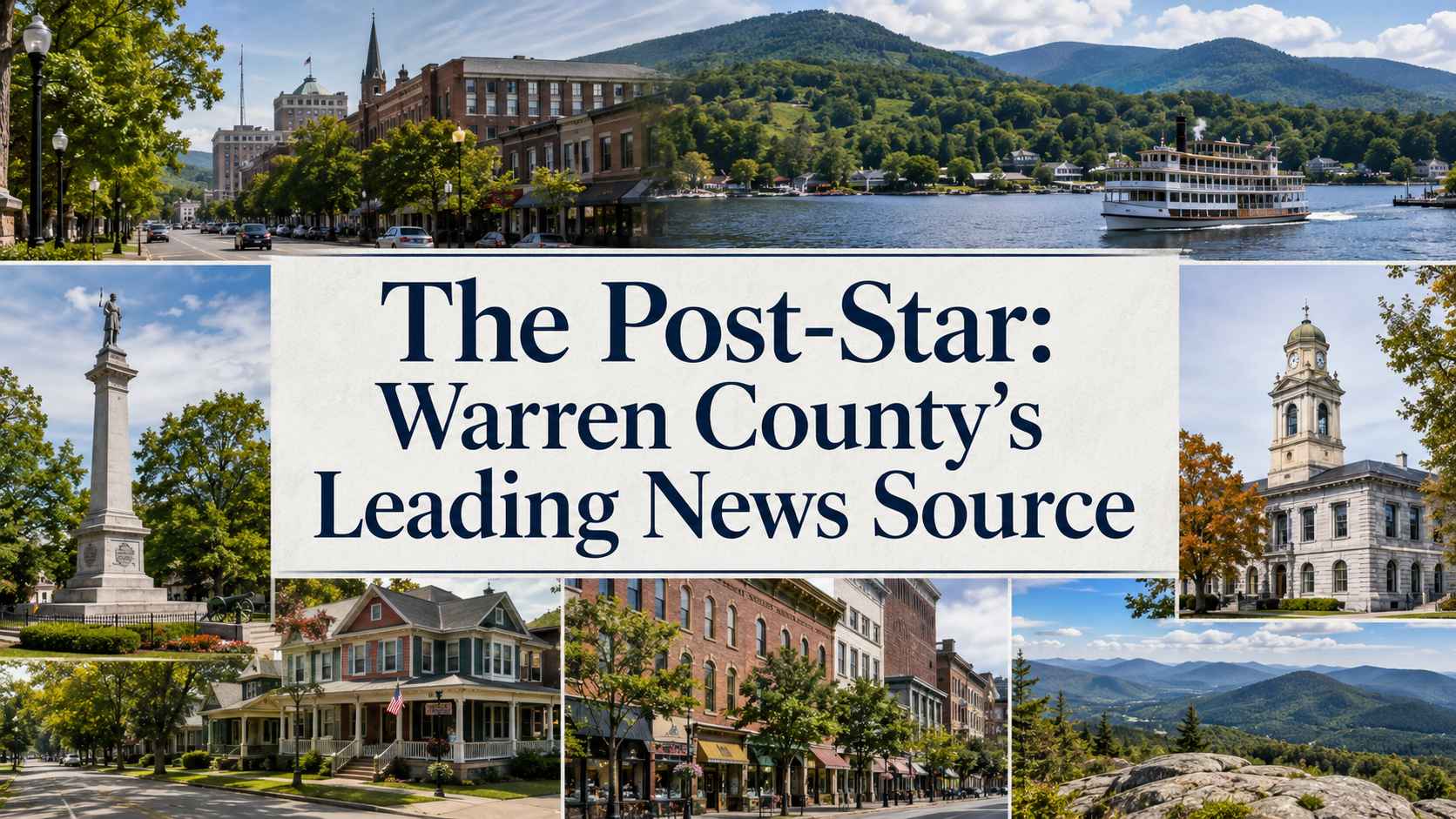

A national headline may shape a conversation, but a county budget, school decision, road closure, court ruling, or zoning vote can change your week before breakfast. The Post-Star remains a leading news source for Warren County because it follows those close-to-home decisions across Glens Falls, Queensbury, Lake George, and the wider southern Adirondack region.
Its value isn’t based on being the loudest outlet in your feed. It comes from continuity. Local reporters return to the same boards, agencies, neighborhoods, teams, and public debates long enough to notice what changed, who reversed course, and which promise quietly disappeared from the next agenda. That kind of memory is hard to replace with scattered social posts.
For readers, the real question isn’t whether one newspaper can cover everything. It can’t. The better question is how to use a regional paper intelligently: what to trust it for, where to look deeper, how print and digital access differ, and why steady local reporting still matters when information is everywhere but context is scarce.
Why It Still Matters
The Post-Star gives Warren County readers a recurring, organized view of local government, public safety, schools, business, sports, community life, and regional issues. Its strongest role isn’t simply announcing events. It is connecting today’s development with the public record and the decisions that came before it.
Local News Backbone
A county doesn’t experience news as one neat stream. Glens Falls may be debating a city issue while Queensbury residents are watching development, Lake George businesses are preparing for a seasonal rush, and northern towns are dealing with road, emergency-service, or broadband concerns. The reporting challenge is to treat those places as connected without pretending they are identical.
That is where a regional newsroom earns its place. The Post-Star’s website brings together local reports with sports, weather, business, lifestyle coverage, obituaries, opinion, and state or national stories that have a clear local audience. Its local section explicitly centers Glens Falls and Warren County, while its government and politics coverage continues to identify reporting focused on the Warren County Board of Supervisors.
The basic product is easy to underestimate. A reader sees a headline. Behind that headline may be a meeting agenda, interviews, public documents, prior coverage, a follow-up call, and the judgment to explain what matters without reproducing every procedural detail. The finished article looks simple because the sorting has already happened.
I’ve noticed a recurring mistake in discussions about local media: people compare a newspaper with the total volume of information available online. That is the wrong contest. No newsroom can beat the internet at volume. The useful comparison is between reported, edited information and the pile of unverified fragments that reaches you through neighborhood groups, screenshots, forwarded texts, and clipped video.
A local paper also creates a shared starting point. Residents may disagree sharply about taxes, policing, tourism, development, or school policy, but they can at least argue from a common set of reported facts. Once that common ground disappears, every public issue becomes a contest between private information bubbles. It gets noisy fast.
What Does The Post-Star Cover for Warren County Readers?
The answer is broader than breaking news, though breaking events often pull the most attention. The paper’s daily usefulness comes from covering institutions that keep moving even when they aren’t trending: county government, municipal boards, courts, law enforcement, schools, hospitals, local employers, civic organizations, and high school sports.
Warren County itself contains a mix of city, suburban, village, lake, and mountain communities. The county’s official municipality list includes Glens Falls, Queensbury, Lake George, Bolton, Chester, Hague, Horicon, Lake Luzerne, Stony Creek, Thurman, and Warrensburg, among others. That spread matters because a story about occupancy-tax spending near Lake George has a different audience and set of consequences than a street project in Glens Falls or an emergency-service concern in a smaller town.
Good regional coverage recognizes those differences while showing where they meet. Tourism policy affects tax revenue and seasonal employment. Housing affects hiring. School enrollment affects budgets. Road conditions affect residents, visitors, and first responders at the same time. One local issue often travels farther than its first headline suggests.
The Post-Star also covers crime and courts, local business, history, entertainment, and sports. Those categories aren’t side dishes. Court reporting helps readers distinguish a filed charge from a conviction. Business reporting shows what an opening, closure, redevelopment plan, or ownership change could mean beyond a ribbon-cutting photo. Sports coverage records achievements that larger outlets would never see. The history section gives current debates a longer shadow.
For a practical example, consider a proposed commercial project in Queensbury. A useful local report may need to explain the parcel, zoning questions, traffic concerns, planning-board comments, the developer’s argument, and the next public meeting. A social post may capture one angry exchange. The article’s job is to show the whole mechanism, including the boring parts that determine the outcome.
And boring can be important. That may be the most local-news sentence there is.
A Newspaper Shaped by Glens Falls and Warren County
The Post-Star’s identity is tied to Glens Falls, but its relevance has always depended on looking outward into surrounding communities. Newspaper records held by the New York State Library trace the Post-Star title to 1909, following earlier Glens Falls papers including the Morning Post and Morning Star. Those records also show later title changes and continuations, a reminder that local newspapers often evolve through mergers, new owners, changing formats, and shifting distribution rather than moving in a straight line.
History matters here for a practical reason. A newsroom that has covered the same area for generations builds an archive of public arguments. The names change. The recurring pressures do not: growth versus preservation, public access versus private control, tourism revenue versus resident concerns, spending demands versus tax resistance. Old stories don’t settle new debates, but they reveal patterns that would otherwise look brand-new.
The paper’s most prominent national recognition came in 2009, when Mark Mahoney received the Pulitzer Prize for editorial writing. The Pulitzer citation praised editorials focused on the dangers of secrecy in local government and on citizens’ right to know. That award is relevant not because every reader agrees with every editorial position, but because it points to a core function of local journalism: insisting that public business remain visible.
There is a useful distinction between institutional memory and institutional loyalty. A newspaper should know its community deeply without becoming a booster sheet for it. The moment coverage treats local officials, major employers, tourism interests, or familiar civic figures as beyond hard questioning, the archive becomes decoration instead of accountability.
From years of comparing local outlets, I’ve found that readers often sense this distinction before they can name it. They notice when stories keep asking the next question. They also notice when coverage becomes a string of announcements dressed as reporting.
Geography Makes the Job Harder
Warren County looks compact on a state map, but reporting across it involves very different rhythms. Glens Falls has the density of city government, downtown business, health care, arts, and neighborhood concerns. Queensbury brings large-scale development, retail corridors, schools, and suburban growth. Lake George and nearby communities carry the pressure of a visitor economy, environmental stewardship, seasonal traffic, and lake-centered policy.
Move north or west and the reporting equation changes again. Smaller towns may have fewer meetings, fewer full-time public-information staff, and longer distances between events. A single highway issue, ambulance shortage, cell-service gap, or school decision can carry outsized weight. These stories are easy for larger regional media to miss because they don’t always arrive with polished press releases.
That uneven geography creates a fairness problem. Population naturally pulls coverage toward the places with more people, more institutions, and more frequent events. Yet the smallest communities may need local reporting most because they have fewer alternative outlets watching them. A healthy regional paper has to resist letting the news map shrink to its busiest zip codes.
The tangent is that Adirondack identity itself can become a kind of shorthand. People talk about “the Adirondacks” as though one label explains housing, tourism, conservation, labor, and local government across a huge area. It doesn’t, but that’s a different article.
For readers, geography should shape expectations. You may see more frequent coverage from Glens Falls and Queensbury, but that doesn’t make northern-town reporting optional. One way to judge the paper over time is to watch whether it returns to places after the dramatic moment passes. The first story gets attention. The follow-up proves commitment.
What Most People Get Wrong About Local Newspapers
The laziest criticism is that a local paper should publish every fact for free, cover every meeting, update every story instantly, and still maintain a full reporting staff without asking readers to pay. That argument usually arrives from people who would never demand unlimited labor from any other local service. It’s mildly maddening because it treats reporting as if it appears automatically once an event happens.
News doesn’t collect itself. Public records must be found and read. Officials have to be questioned. Claims need checking. A reporter may sit through two hours of routine discussion because the consequential vote happens in the final ten minutes. Editors then have to decide what is solid, what needs another call, what belongs in the headline, and what could mislead if stripped of context.
Another bad assumption is that social media has replaced local journalism. Social media is excellent at signaling that something happened. It is weaker at verification, proportion, and follow-through. A resident may post a photo of emergency vehicles and get the location right but the cause wrong. A political clip may be authentic but omit the exchange that prompted it. A screenshot of a proposal may be genuine but outdated.
No, newspapers are not error-proof. They make mistakes, miss stories, choose weak angles, and sometimes move too slowly. The difference is that a responsible newsroom has named authors, editorial review, correction practices, and a public reputation attached to the work. That structure doesn’t guarantee perfection. It creates accountability for imperfection.
The pattern I keep seeing is that people say they want “unbiased news” when they often mean news that doesn’t irritate them. Fair reporting can still be uncomfortable. It may quote an official you distrust, explain a legal limit that weakens your preferred argument, or show that a rumor from your own side isn’t supported. Neutrality isn’t the absence of unpleasant facts.
There is also a nostalgia trap. Some readers judge today’s paper against a thicker print edition from decades ago without accounting for the advertising revenue that once paid for much of that size. The loss is real. Pretending the economics never changed won’t rebuild a newsroom.
Use the Paper Like a Local Research Tool
Reading local news passively is better than ignoring it, but you get more value when you treat the paper as a living index of public life. One article can lead you to a meeting, a document, a previous dispute, or a person responsible for the next decision. The goal isn’t to consume more headlines. It is to become harder to surprise.
A simple routine works:
- Check the main local-news page once a day, then scan government, crime and courts, business, and sports only when those beats matter to you.
- Open stories tied to your town, school district, commute, taxes, employer, or neighborhood even when the headline sounds procedural.
- Follow names and institutions across time. A budget proposal, zoning application, lawsuit, or school plan rarely makes sense as a single article.
- Compare the report with the original agenda, minutes, court record, or public document when the issue affects your money, property, vote, or family.
- Save or share the article with a useful note about why it matters instead of forwarding only the headline.
- Revisit the topic after the vote, hearing, deadline, or election. The outcome is often less dramatic and more important than the initial conflict.
That process takes minutes, not hours. It also fixes a common problem: people read the first story in a dispute and miss the decision three weeks later. Local government moves on calendars, not on the attention span of a social feed.
You can make the habit even lighter by choosing two fixed check-in times each week. Keep one browser folder for ongoing local issues, and rename saved links with the decision date or meeting body. In a household, divide the watch: one person follows schools, another tracks town government, and both flag stories tied to taxes, closures, or public hearings. The point isn’t to build a private newsroom. It’s to stop important local developments from arriving as surprises after the public comment period has already closed.
Suppose the county board is considering a spending change. The first article may explain the proposal. A later story may cover committee debate. Another may report amendments or public objections. The final vote could alter the amount, timing, or funding source. Reading only the first headline leaves you informed about an idea that no longer exists in its original form.
For broader browsing, the Warren County local news archive can help you see how different outlets and stories fit into the same regional conversation. Use it as a discovery layer, then read the original reporting closely when a decision directly affects you.
One analyst habit is especially useful: search by the institution, not only the controversy. If you follow “Warren County Board of Supervisors,” “Glens Falls Common Council,” a school district, or a planning board over several months, you’ll see quieter stories that explain the loud one later.
Print, Digital, and the Real Trade-Offs
The Post-Star now operates in the same difficult space as most regional newspapers: readers expect immediate digital updates, while many long-time subscribers still value a printed edition. Those products serve different habits. Digital is faster and searchable. Print is finite, browsable, and easier for some readers to absorb without alerts or competing tabs. The difference is not merely age or preference. A printed page encourages accidental discovery: you may notice a school story beside the article you intended to read. Digital access is better when you need a name, date, update, or older report quickly.
In July 2023, The Post-Star shifted to an expanded print edition on a Tuesday, Thursday, and Saturday schedule. The change reflected a broader move away from the old assumption that a printed newspaper must arrive in the same form every day, even while digital publishing continues between print dates.
| Option | Best for | Main strength | Main trade-off |
|---|---|---|---|
| Website access | Breaking updates and searchable coverage | Speed and easy sharing | Can feel fragmented if you only read headlines |
| E-edition | Readers who like the newspaper layout | Familiar page-by-page experience | Requires a screen and may feel less immediate |
| Print edition | Focused reading and household sharing | Calm, curated presentation | Fewer delivery days and no instant updating |
| Social feeds | Alerts and story discovery | Fast awareness | Algorithms can hide important but less popular news |
| Mixed routine | Regular local-news followers | Combines speed, depth, and habit | Requires a little discipline |
Costs and subscription offers change, so exact pricing should be checked at the time you subscribe. The more useful question is what you are paying for. You’re not buying every fact on the website as if articles were items in a warehouse. You’re supporting the reporting capacity that makes future coverage possible.
There are downsides. Paywalls can frustrate occasional readers, especially when a safety issue or major public event is developing. Digital pages can be busy. Print delivery changes can disrupt routines. Corporate ownership may also raise fair questions about staffing, local autonomy, and how much revenue returns to reporting.
Those concerns deserve scrutiny, not slogans. Lee Enterprises owns The Post-Star, and like other newspaper companies it has faced the hard economics of declining print advertising and the need to grow digital subscriptions. Recent company-level changes and investment promises make newsroom reinvestment a question worth watching rather than assuming.
My view is blunt: a subscription is not a charity donation, and readers are entitled to expect useful reporting, responsive service, and visible local commitment. But expecting strong coverage while refusing any paid model is not a serious long-term plan.
Accountability Is the Product
Breaking news attracts clicks, but accountability is the more durable product. A newspaper earns trust when it shows who made a decision, what authority they used, what money is involved, who benefits, who carries the risk, and what happens next. That work is often slow and stubborn. It may produce no viral moment at all.
Warren County’s government structure gives reporters plenty to track. The Board of Supervisors functions as both the county’s legislative and executive branch, and county government publishes meeting dates, minutes, videos, budgets, resolutions, and other records. Those public materials are valuable, but they are not a substitute for reporting. Documents tell you what was filed or approved. Journalism asks why, tests claims, and brings affected people into the story.
A concrete example is a county budget. The final number alone tells you little. Readers need to know which services grew, what was reduced, whether reserves were used, how tax rates may change, what assumptions depend on state or federal funding, and which costs were pushed into future years. The meeting vote is one moment. The budget’s consequences unfold across departments.
The same principle applies to public safety. Early information is often incomplete because responders are still working, witnesses disagree, and agencies may be limited in what they can release. Speed matters, especially during a road closure, fire, search, or major storm. Accuracy matters more. A credible local outlet should update what changed and clearly separate confirmed facts from open questions.
I’m skeptical of any news brand that measures local relevance mainly by how many stories it posts. Volume can hide thin reporting. One deeply sourced article about a public project may serve readers better than a dozen rewrites of announcements. The test is consequence: did the coverage help you understand power, money, safety, opportunity, or community change?
Accountability also includes corrections. Readers should expect errors to be fixed clearly, not silently buried. Trust doesn’t require pretending mistakes never happen. It requires a visible method for dealing with them.
Reading Beyond Breaking News
Some of the paper’s most useful work sits outside the urgent-news cycle. High school sports, obituaries, local history, arts coverage, business profiles, and community events build a record of who lived in the region and what people valued. These stories don’t always challenge power, but they preserve identity in a way a statewide outlet rarely can.
Sports coverage is a good example. A regional result may be a tiny item to a national platform and a major family record to the people involved. The value isn’t only the score. It is the names, season arc, rivalry, setback, and recognition of students whose efforts happened outside the narrow spotlight of elite athletics.
Obituaries serve another role. They are personal notices, but taken together they become a community archive of work, service, migration, family ties, military history, volunteer activity, and local institutions. Readers often discover connections they didn’t know existed. That quiet social map has real worth.
Business and cultural coverage can also reveal change before it shows up in official statistics. A new employer, a long-running shop’s closure, a theater season, a housing project, or a shift in tourism activity may signal where the region is heading. Not every opening is a trend. Not every closure is a crisis. Good reporting resists both boosterism and doom.
The surprise is that “soft news” can make hard news easier to understand. You grasp a school debate differently when you know the district’s teams, traditions, enrollment concerns, and community expectations. You understand downtown policy better when you’ve followed the businesses and cultural groups trying to operate there.
How Should Readers Judge The Post-Star Over Time?
Don’t judge a local newspaper by one headline you loved or one editorial you hated. Watch its habits. Does it correct errors? Does it return to unfinished stories? Does it quote people beyond officials and press releases? Does it explain documents in plain language? Does it cover smaller communities when no spectacle is involved?
Consistency is more revealing than perfection. A newsroom will miss things. It will publish stories you find unimportant and give less attention to issues you care about. The fair question is whether the overall record shows independence, curiosity, local knowledge, and a willingness to ask uncomfortable follow-ups.
Look at source variety, too. A story about a school dispute shouldn’t rely only on administrators. A development story needs more than the applicant’s description. A crime report should avoid treating an accusation as a verdict. An election story should explain stakes and records, not merely repeat campaign language.
Another pattern I’ve noticed: readers often complain that local reporting is “negative” when it covers conflict, then complain that it is “public relations” when it covers community achievements. A good paper has to do both without confusing their purposes. The watchdog and the town chronicler share a newsroom, but they aren’t the same job.
You can also test usefulness personally. After a month of regular reading, do you know more about upcoming decisions before they happen? Can you name the public body responsible? Do you understand why a project is delayed, what a tax proposal funds, or when public comment is possible? If the answer is yes, the coverage is doing more than filling a feed.
Frequently Asked Questions
Is The Post-Star a local newspaper for Warren County?
Yes, The Post-Star is based in Glens Falls and focuses heavily on Glens Falls, Warren County, and nearby communities. Its coverage also reaches into surrounding parts of the southern Adirondack and Capital Region area, depending on the topic, public institution, sports conference, or regional impact.
Who owns The Post-Star newspaper?
Lee Enterprises owns The Post-Star. Corporate ownership does not automatically tell you the quality of an individual local story, but it does make staffing, investment, subscription strategy, and local decision-making fair subjects for readers to watch over time.
How often is The Post-Star printed?
3 print editions are scheduled each week: Tuesday, Thursday, and Saturday. Digital publishing continues outside those print days, so readers who want current updates should use the website or digital products rather than waiting for the next physical edition.
Can I read The Post-Star without a subscription?
Honestly, it depends. Access rules, free-article limits, promotional offers, and subscriber benefits can change. Some material may be open while other reporting requires payment. Check the current terms directly rather than relying on an old price or access rule shared elsewhere.
Did The Post-Star win a Pulitzer Prize?
The newspaper’s Mark Mahoney won the 2009 Pulitzer Prize for editorial writing. The recognized work addressed secrecy in local government and encouraged citizens to defend their right to know, making the award closely connected to the watchdog role of community journalism.
Is social media enough for Warren County breaking news?
No, social media is useful for fast alerts but unreliable as a complete news system. Posts may lack verification, context, updates, or a clear distinction between allegation and fact. Use social platforms to notice a development, then look for reported confirmation and follow-up.
What kinds of local stories are most valuable to follow?
Government budgets, school decisions, development proposals, public safety, courts, housing, major employers, environmental issues, and infrastructure usually have the clearest long-term effects. Community events, sports, obituaries, and local history matter too because they document the region beyond conflict.
How can I tell whether a local news story is trustworthy?
Start by checking the byline, named sources, documents, dates, and whether the article separates confirmed facts from claims. Then look for follow-up coverage and corrections. A polished headline alone proves little; trustworthy reporting shows how it knows what it says.
Keep Watching the Follow-Up
A leading local newspaper proves its value after the first burst of attention fades. The Post-Star matters most when it keeps following the budget, project, court case, school plan, public-safety issue, or election promise that readers could otherwise lose in the churn.
Your next step is simple: choose one Warren County institution that affects your life and follow its coverage for the next month. Read the first report, the public documents, and the outcome. That small habit will tell you more about local power than a week of random headlines.
From an analyst’s view, the strongest local news source isn’t the one that agrees with you most often. It’s the one that keeps your community’s decisions visible when nobody is paying attention.