
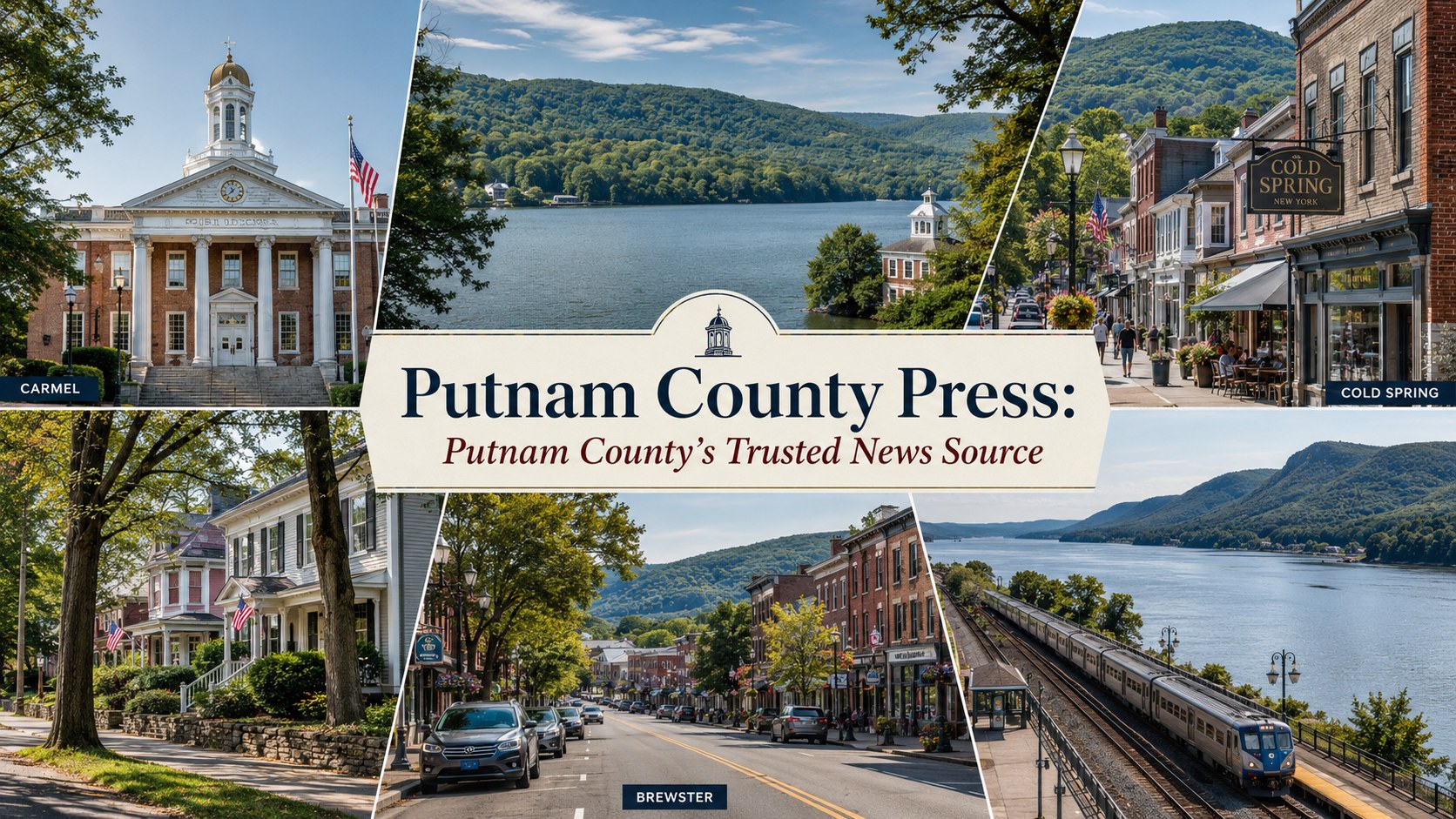

Local news deserves more than recycled regional headlines. The Putnam County Press matters because it stays close to the decisions, schools, public notices, court activity, community events, and town-level debates that shape daily life across Putnam County. A larger outlet may cover the biggest story of the week, but it usually won’t follow the smaller government vote, local fundraiser, school recognition, or neighborhood dispute that residents keep talking about after the cameras leave.
That narrow focus is the paper’s strength. It is also the reason readers should understand what the publication does well, where its limits show, and how to use it alongside other sources. The best local-news habit isn’t blind loyalty to one outlet. It’s knowing which source is built to notice the details others miss. For residents in Carmel, Mahopac, Kent, Patterson, Brewster, Southeast, Philipstown, and Putnam Valley, a county newspaper can still provide something that broad regional coverage rarely does: continuity.
Why This Paper Matters
The Putnam County Press is valuable because it follows Putnam County as a place, not as a side topic. Its strongest work centers on local government, schools, crime, community life, public notices, and town-specific developments. Readers get the most from it when they treat it as a steady county record, then compare major or fast-moving stories with official documents and wider regional reporting.
What Makes a County Newspaper Worth Trusting?
Trust in a local newspaper doesn’t come from a slogan. It comes from repetition. A paper earns attention by showing up for the routine matters that don’t look dramatic on publication day but become significant over time: board appointments, school decisions, budget discussions, zoning changes, police updates, local elections, civic events, and the steady churn of people and institutions.
That’s where county reporting separates itself from drive-by coverage. A regional newsroom may arrive when a story becomes large enough to interest readers across several counties. A county paper has a different job. It needs to notice the meeting before the controversy, the proposal before the vote, and the community response before outsiders decide the story has become newsworthy.
The Putnam County Press benefits from a clear geographic identity. Putnam isn’t one town with a few surrounding neighborhoods. New York State lists six towns and three incorporated villages in the county, and the concerns of Brewster, Carmel, Cold Spring, Kent, Patterson, Philipstown, Putnam Valley, and Southeast don’t always line up neatly. A source that organizes coverage around those places gives readers a faster route to what affects them.
I’ve noticed a common mistake when people judge small newspapers: they compare them with metro outlets on volume. That misses the point. The better question is whether a publication records local decisions consistently enough that a resident can follow an issue over several weeks or months. One detailed school-board story may matter more to a parent than twenty state headlines copied from elsewhere.
Trust also depends on knowing what kind of source you’re reading. A local newspaper can report, summarize, contextualize, and preserve a public record. It can’t replace the original budget, court filing, meeting video, election result, or emergency alert. Good readers keep those roles separate (and good local papers make that separation easy).
Here’s Where the Paper Earns Its Keep
The strongest reason to read the Putnam County Press is simple: its coverage menu matches the way residents experience county life. The site separates politics and government from town-based pages for Brewster and Southeast, Carmel and Mahopac, Cold Spring, Garrison and Philipstown, Kent, Patterson, and Putnam Valley. It also maintains dedicated areas for crime, schools, and sports. That structure may sound ordinary, but it solves a real problem. Local readers usually search by place first.
A Carmel homeowner watching a proposed town action doesn’t want to sort through dozens of unrelated Hudson Valley stories. A Patterson parent may care more about a school change, youth event, or road issue than the region’s biggest political argument. A Cold Spring reader often needs reporting that understands village concerns and Philipstown context at the same time. County news works when it respects those differences instead of flattening them.
The outlet also combines two reading habits under one brand family. According to the publication’s own background page, the Putnam County Press is mailed to subscribers and serves as an official newspaper of record for the county, the Village of Brewster, and several towns, while the sister Putnam County Times is distributed free at public and commercial locations around the county. That split gives the operation a useful mix of subscription continuity and broad physical reach.
| Source type | Best use | Main advantage | Main limitation |
|---|---|---|---|
| Putnam County Press and Putnam County Times | Town news, county government, schools, crime, community events, public notices | Deep local focus and recurring coverage | Smaller staff and narrower reporting scope |
| Regional news outlets | Major breaking stories, state politics, transportation, weather | More reporters and wider context | Routine Putnam issues may receive little attention |
| Government websites and meeting records | Official agendas, laws, budgets, notices, minutes | Primary documents and exact wording | Often lacks plain-language explanation or outside scrutiny |
| Community social media | Immediate tips, photos, neighborhood reaction | Fast and highly local | Rumors, missing context, and uneven verification |
The table points to a better reading strategy. Don’t ask one source to perform every job. Use the county paper for continuity and local framing. Use official records when exact language matters. Use regional outlets for broader context. Treat social posts as leads, not proof.
The paper’s physical distribution still deserves attention too. Its listed pickup locations include libraries, town halls, supermarkets, diners, and other familiar stops across Brewster, Carmel, Kent, Mahopac, Patterson, Philipstown, and Putnam Valley. That kind of placement reaches people who may never subscribe to an email alert or search for a local story online. A paper sitting near a library entrance can still introduce a resident to an issue they didn’t know to search for.
And that’s the part digital-only thinking often misses. Discovery matters. You can’t search for a story you don’t know exists.
The Official-Record Role Changes What Readers Get
A newspaper of record carries a different kind of local weight. The phrase doesn’t mean every article is automatically correct or that readers should stop checking primary documents. It means the publication has an established role in carrying legal notices and other information that public bodies are required to publish. That function turns the paper into part of the county’s civic information system, not merely a collection of features and headlines.
For a resident, that matters in practical ways. Public hearings, bid notices, local laws, tax-related notices, estate matters, and other legal advertisements can affect property, business, development, and government accountability. These items may look dense. They often are. But they create a public trail, and a local newspaper helps keep that trail visible outside a government office.
The Press says it is the official newspaper of record for Putnam County, the Village of Brewster, and the towns of Patterson, Kent, Southeast, and Carmel. Readers shouldn’t interpret that status as an endorsement of every editorial choice. They should see it as a reason to pay attention to the paper’s legal and government pages, especially when a local issue begins quietly.
Here’s a realistic example. Suppose a town is considering a change that could affect a nearby road, development proposal, service district, or public facility. The first meaningful signal may not be a dramatic news story. It may be a notice, an agenda item, or a short report from a meeting. People who wait for controversy to reach social media often enter the conversation late, after the easiest chances to ask questions have passed.
The pattern I see across local-news reading is that residents say they want accountability coverage, but many skip the routine notices and meeting reports that make accountability possible. The exciting story is usually the final chapter. The dull-looking document is often chapter one.
That’s why the Press works best as a habit rather than an occasional emergency visit. Scan it regularly. Notice repeated names, proposals, departments, and unresolved questions. Local government is easier to understand when you watch it accumulate instead of trying to decode one heated meeting in isolation.
What Most People Get Wrong About Small Local Papers
The laziest criticism of a county newspaper is that it doesn’t look or move like a large digital newsroom. Well, yes. That’s not a revelation. Small outlets usually have fewer reporters, fewer updates, less visual polish, and less capacity to chase every breaking event by the minute. Judging them only by speed is like judging a town clerk by how closely the office resembles a national call center.
What matters is fit.
Readers consistently underestimate the value of repetition. A short item about a school program may feel minor until it connects with later budget choices. A local business profile may seem soft until the same business becomes central to a development debate or community fundraiser. Sports coverage may not change public policy, but it records the people and institutions that make a place feel like itself. Not every useful story needs an outrage hook.
Another mistake is assuming local means neutral, friendly, or uncritical by default. Community proximity can improve reporting because journalists know the institutions and recurring players. It can also create pressure. Small outlets operate in places where advertisers, officials, readers, sources, and subjects often know one another. That doesn’t prove bias. It does mean readers should notice sourcing, compare claims, and distinguish reported facts from commentary.
I get mildly annoyed when people repeat, “Just follow the town Facebook group.” A group can be excellent for alerts, lost pets, traffic chatter, event reminders, and raw community reaction. It can also turn one partial screenshot into a countywide certainty before anyone checks the agenda, police statement, or full document. Speed feels satisfying. Verification is slower.
The smarter approach is to use community posts as a tip sheet and the newspaper as one verification layer. Then open the source document when the stakes are high. That sounds like extra work, but it usually takes a few minutes, and it prevents the most common local-information failure: arguing confidently about a summary nobody traced back to its source.
People also expect local newspapers to cover every neighborhood event. That expectation ignores basic capacity. A small newsroom has to choose among government meetings, crime, schools, sports, business, features, obituaries, legal notices, and community submissions. The better test is whether the paper makes it easy for residents and organizations to submit legitimate news and request coverage. The publication openly encourages local residents and business owners to send news and event information.
A community paper is partly shaped by what the community sends it. That’s not an excuse for weak reporting. It’s a reminder that local information is a two-way street.
Putnam’s Geography Makes Local Detail Harder Than It Looks
Putnam County is compact on a map, but its communities aren’t interchangeable. The eastern side leans toward Brewster, Southeast, Patterson, and the Interstate 84 and Harlem Line corridor. Carmel and Mahopac have their own civic gravity. The western side, including Cold Spring, Garrison, Nelsonville, and Philipstown, often looks toward the Hudson and carries different development, tourism, preservation, and village concerns. Putnam Valley and Kent add another set of local institutions, roads, school questions, and community rhythms.
That creates a reporting challenge. A countywide story can be accurate and still feel irrelevant to half the county. A town-specific story can be valuable and still leave other readers wondering why it received attention. Editors have to balance geographic fairness with the reality that news doesn’t arrive evenly.
One week may be heavy with county government and Carmel activity. Another may produce a school story in Brewster, a public-safety issue in Kent, and a cultural event in Cold Spring. Artificial balance would be worse than uneven coverage because it would force space toward places without equally strong news. Still, readers are right to notice long gaps. Local trust weakens when a community feels visible only during controversy.
The Putnam County Press addresses this problem by giving several communities their own navigation categories. That design helps, but category labels can’t do the reporting by themselves. The real test is depth: Are stories tied to the correct town? Do they identify the board, agency, school district, or local group involved? Do follow-ups appear after a proposal becomes a vote or a promise becomes a deadline?
My analyst’s view is that local outlets gain more trust from one solid follow-up than from five unrelated event briefs. Readers remember unfinished stories. They want to know what happened after the hearing, after the arrest announcement, after the election, after the fundraiser, or after the school district introduced a plan.
There’s also a regional identity question hiding beneath all this. Putnam sits between major suburban, exurban, and Hudson Valley influences, and residents don’t always agree on which identity fits best. That affects politics, development, commuting, conservation, housing, and even which outside news outlets people read, but that’s a different article.
For this paper, the practical lesson is narrower. Town labels should help readers enter the coverage, while countywide reporting should explain why an issue in one place matters beyond its border. A road project in Southeast can affect commuters from elsewhere. A county budget decision can shape services in every town. A western Putnam preservation debate can raise questions that later appear in another municipality.
The best local journalism connects those dots without pretending every dot is the same size.
The Costs, Limits, and Trade-Offs Deserve an Honest Look
Local reporting is expensive in the least glamorous way. Meetings run long. Public records take time. A reporter may spend hours on a story that attracts fewer clicks than a dramatic crime headline. Printing, mailing, design, photography, editing, web hosting, insurance, and basic administration all cost money before a single issue reaches a reader.
That financial reality shapes what small papers can do. Subscription revenue helps. Advertising helps. Legal notices can help. Community support helps. None of those income streams is perfectly stable, and each creates its own tension. A publication needs advertisers without becoming an advertising brochure. It needs subscribers without hiding all public-interest reporting. It may depend on official notices while still needing to scrutinize government.
Readers should expect trade-offs rather than pretending they don’t exist.
A weekly publication may not be the first source for a fast emergency. By the time print arrives, a road closure, storm warning, police search, or election-night result may have changed. The website and social channels can narrow that delay, but a small newsroom still won’t match a television station or large digital outlet for constant updates. That’s a real limitation, not a moral failure.
The opposite trade-off is more interesting. Fast outlets often leave routine local matters behind once the immediate headline fades. A county paper can return to the same institutions every week. That slower rhythm may produce a better record even when it loses the race for the first alert.
In April 2026, the Putnam County Press reported that the Putnam County Courier and the Putnam County News & Recorder had closed. The loss of long-running local titles changes the county’s information environment. Fewer outlets can mean fewer reporters at meetings, fewer editorial judgments, fewer competing versions of the same event, and fewer chances for a missed story to be picked up elsewhere. Competition isn’t wasteful in journalism. It is a form of backup.
This is where popular advice diverges from reality. People say, “Someone online will cover it.” Sometimes someone does. But a resident livestream, a campaign page, an agency statement, and a community rumor account aren’t interchangeable with an editor assigning a story, checking facts, calling more than one source, and publishing a correction when needed.
The Putnam County Press also carries the burden of serving readers with different expectations. Some want hard government reporting. Others open the paper for school news, sports, local personalities, business updates, or community events. A publication that serves only the loudest political readers may gain heat and lose breadth. One that avoids conflict may feel pleasant and become less useful.
No local paper gets that balance right every week. Readers can still judge the direction. Does the outlet publish information that helps you act? Can you find the source of a claim? Does it separate a press release from independently reported work? Does it return to unresolved issues? Those questions reveal more than the number of stories posted in a day.
And there is a cost on the reader’s side too. A subscription asks for money. Regular reading asks for time. Verification asks for attention. Yet the alternative isn’t free. Confusion, rumor, missed hearings, and late discovery carry costs of their own, especially when property, schools, taxes, development, or public safety are involved.
A Better Way to Read Putnam County News
You don’t need to turn local news into homework. A simple routine can keep you informed without letting every alert consume your day. The goal is to catch the decisions that affect you, understand the larger county pattern, and avoid getting pulled into arguments built on incomplete information.
- Scan by town first. Start with the place where you live, work, own property, or have children in school. Read headlines for nearby communities too, because county services, roads, school partnerships, and political decisions often cross town lines.
- Check government and schools every week. These beats generate slow-moving stories with long consequences. Look for budgets, appointments, hearings, policy changes, contracts, capital projects, calendars, and follow-up votes.
- Open the original record when the stakes are high. A news report should help you understand an issue, but agendas, minutes, budgets, court records, election results, and agency statements provide the exact language. Compare the two rather than choosing one.
- Use social media for discovery, not final judgment. Save posts that point to a real event or document. Ignore the pressure to react before you’ve checked the source. A confident caption can still be wrong.
- Revisit unresolved stories. Search the paper’s archive, watch for later meeting coverage, and note whether promised actions occurred. Local accountability often appears in the follow-up, not the first headline.
The publication’s archive shows a continuing run of weekly digital editions, including issues throughout the first half of 2026. That makes it more useful than a feed designed only around the newest item. Archives let you trace what officials said earlier, compare coverage across time, and recover details that disappear from social chatter within days.
A realistic reading session might take fifteen minutes. You open the latest edition, scan your town, read one government story, check schools or public safety, and save one issue that needs follow-up. That’s enough. You don’t have to read every feature or legal notice to benefit from the paper.
I also recommend comparing the paper’s coverage with a broader local source when a story has regional consequences. Our own Putnam County local news coverage can help place county developments within the wider Hudson Valley conversation. The point isn’t to collect outlets like trophies. It’s to notice where their coverage overlaps, where it differs, and what each one leaves unexplained.
For direct access to the publication’s current stories, town categories, archives, and newspaper information, visit the Putnam County Press and Putnam County Times website. The homepage also promotes its current digital edition and invites residents and local businesses to submit news or request event coverage.
The habit becomes easier once you stop expecting one article to settle everything. Local issues are usually processes. Read them that way.
Local News Habits
A trusted news source is partly built by the newsroom and partly built by the reader. The newsroom has to report carefully, label opinion, correct errors, follow stories, and resist turning every disagreement into spectacle. Readers have to slow down long enough to separate a report from a rumor and a public record from someone’s interpretation of it.
That shared responsibility sounds old-fashioned. It isn’t. Digital tools make local information easier to distribute, but they also make fragments easier to mistake for the whole. A clipped video removes what happened before. A screenshot hides the next paragraph. A meeting comment travels without the response that followed. By the time the full context appears, the first version may already feel true.
The pattern I keep seeing is that readers trust familiarity, even when familiarity comes from repetition rather than evidence. A claim shared in five neighborhood groups may still trace back to one unverified post. A small newspaper can interrupt that loop by calling the agency, checking the document, or asking the person named. It won’t catch every mistake. No outlet does. But the process matters.
Readers can strengthen that process by sending precise corrections and useful tips. “You’re wrong” rarely helps. “The meeting minutes list a different date on page four” does. “You ignored my town” is easy to dismiss. “This board votes Tuesday on a proposal affecting three neighborhoods, and here is the agenda” gives an editor something concrete to evaluate.
Community participation also improves the softer parts of the paper. School honors, nonprofit work, local history, business openings, arts events, veterans’ programs, youth sports, and civic milestones don’t always generate formal press coverage. Residents often know about them first. Sharing accurate details, names, dates, and photos helps preserve a fuller record of county life (the small stuff is often what people search for years later).
Trust grows when the paper is useful before a crisis. Read it when nothing dramatic is happening. That’s when you learn which agencies matter, which officials hold responsibility, and which issues keep returning.
Frequently Asked Questions
Is the Putnam County Press the same as the Putnam County Times?
Yes, they are sister publications connected through the same local news operation, but they serve readers differently. The Press is mailed to subscribers, while the Times is distributed free at locations around the county. Their shared website brings current reporting, categories, archives, and publication information together.
Does the Putnam County Press cover every town in Putnam County?
No, not every community will receive equal space in every issue. The website organizes news around major town and community groupings, including Brewster and Southeast, Carmel and Mahopac, western Putnam communities, Kent, Patterson, and Putnam Valley. Coverage depends on news value, staffing, timing, and available information.
How often should I check a local county newspaper?
One focused check each week is enough for many readers. Scan your town, county government, schools, public safety, and any issue you’re already following. During elections, storms, emergencies, budget season, or a major local dispute, check more often and compare updates with official sources.
Can I rely on the paper for breaking emergencies?
Honestly, it depends. A local paper may publish quick online updates, but emergency agencies, municipal alerts, weather services, and police or fire channels are usually better for immediate instructions. Use the newspaper for verified reporting, explanation, community impact, and follow-up after the first alert.
Why does newspaper-of-record status matter?
Newspaper-of-record status matters because legal notices and other public information are published through an established local outlet. It does not make every news article an official government statement. The common misconception is that “official newspaper” means government-controlled; the role is tied to public notice, not automatic approval.
Can residents submit news and event information?
Residents can submit local news, press releases, event details, and coverage requests through the publication’s contact options. A clear submission has a specific date, location, organizer, contact person, accurate names, and a short explanation of why the event or development matters to Putnam County readers.
Is a local newspaper still useful when social media is faster?
Speed isn’t the only measure of usefulness. Social media can surface a tip within minutes, while a newspaper can verify details, contact the people involved, add background, and preserve the story in an archive. The strongest reading habit uses both, but assigns them different jobs.
A Practical Final Take
Putnam County needs reporting that remembers what happened last week, not only what is trending this hour. The Putnam County Press earns its place by following town government, schools, public safety, community life, legal notices, and the ordinary local developments that larger outlets often skip. Its limits are real, especially on speed and staffing, but those limits don’t erase the value of continuity.
Today, open the latest edition and choose one issue that affects your town. Read the report, find the original agenda or public document, and save both for the next update. That single habit will make you a sharper reader than reacting to a dozen disconnected posts.
Local trust isn’t built by declaring a source perfect. It’s built by watching who keeps showing up, checking the record, and returning to the story.