
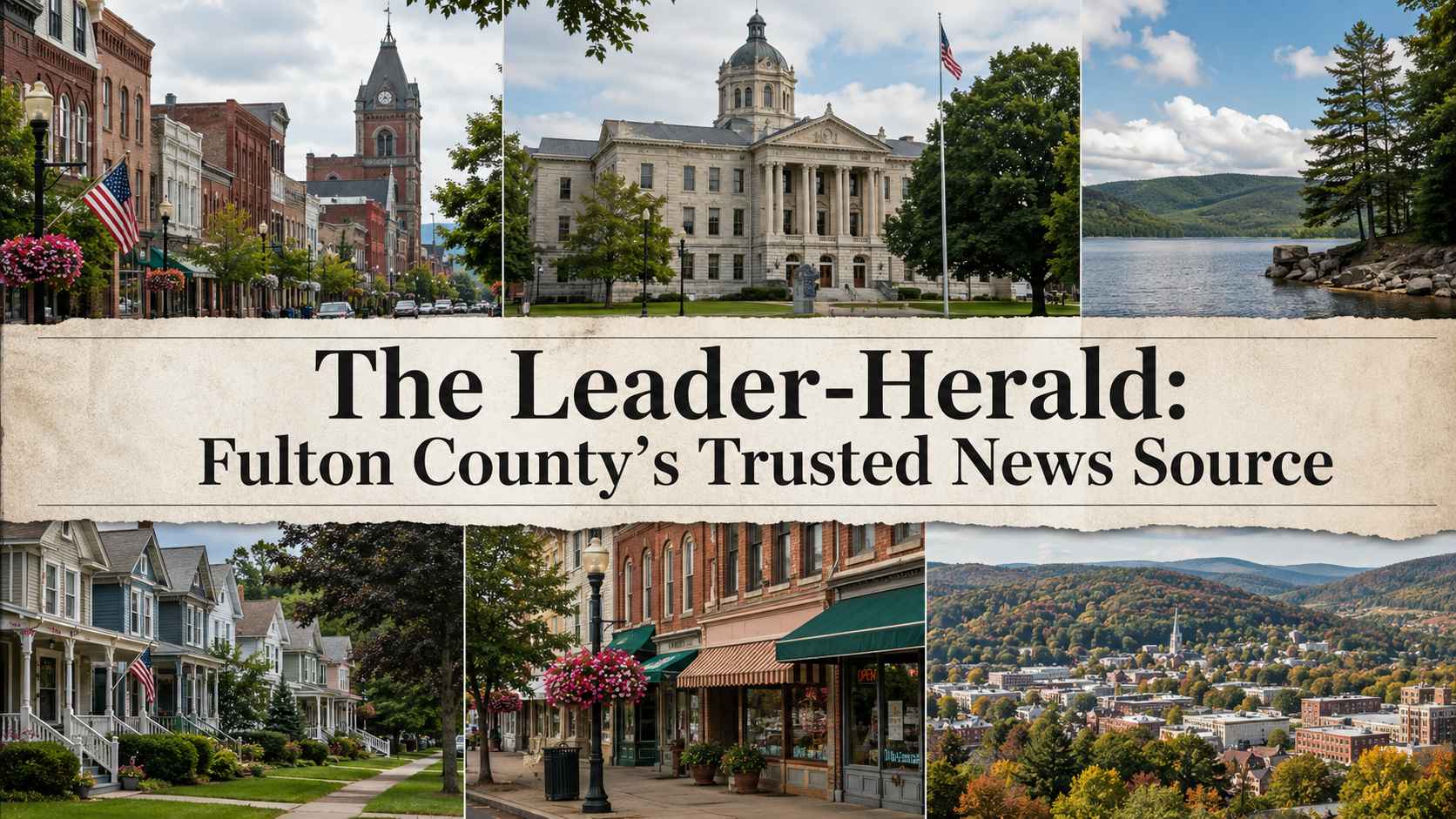

Because the biggest Fulton County stories rarely stay in one lane. A school decision can affect property taxes, a redevelopment plan can reshape traffic, and a factory announcement can raise questions about jobs, water, roads, and public spending all at once. That overlap is where local reporting earns its place.
The Leader-Herald provides readers with a focused way to follow the communities, institutions, and public decisions that shape daily life across Fulton County. Its value is not based on publishing the loudest headline. It comes from staying close to stories after the initial announcement, when meeting votes, public records, neighborhood concerns, and practical consequences begin to matter.
Local readers usually already know the names of their cities and elected officials. What they need is context. They want to know what changed, who made the decision, what happens next, and whether a proposal will affect their street, school district, business, or tax bill. A useful county news source answers those questions without treating small communities as footnotes to a larger regional story.
Why The Leader-Herald Matters
The Leader-Herald matters because it keeps Fulton County issues visible through regular reporting on local government, public safety, schools, business activity, community events, and the people behind them. Its strongest role is connecting individual announcements to the longer local story, giving residents information they can use rather than headlines they’ll forget by tomorrow.
Local reporting has a memory
National outlets often cover a community only after something unusual happens. A major fire, election dispute, criminal case, severe storm, or large development proposal may bring outside attention for a few days. Then the wider news cycle moves somewhere else.
A county newspaper works differently. Its reporters and editors operate within an ongoing record. A proposed project isn’t merely a fresh announcement because earlier promises, zoning discussions, funding requests, and public objections may already exist. That history changes the meaning of new information.
The publication itself carries a long local record. The New York State Library lists The Leader-Herald as a newspaper title dating to 1955 and notes that it continued two earlier publications, the Morning Herald and The Leader-Republican. That background doesn’t make every article correct by default. No newspaper gets that privilege. It does mean the publication has accumulated decades of reporting tied to the same area.
A pattern I’ve noticed while comparing local news sources is that continuity becomes more valuable as stories become less dramatic. Readers can usually find breaking details about a major emergency from several places. The harder information involves a budget amendment discussed months later, a delayed construction schedule, a changed permit, or a public promise that quietly becomes smaller.
Those follow-up details rarely travel far on social media. They don’t have the sparkle of a first announcement. Still, they’re often where the real outcome appears.
Local reporting also creates a shared reference point. Residents may disagree sharply about a city proposal, county policy, school decision, or police response. A reported account gives those disagreements a common set of names, dates, votes, and statements. Without that base, public debate can dissolve into screenshots and secondhand claims.
The Leader-Herald became part of The Daily Gazette organization after a 2021 acquisition. Contemporary reports described the Gloversville publication as a long-running newspaper serving Fulton County and nearby areas. The ownership change connected the local title with a broader regional news operation while preserving a recognizable place for Fulton County coverage.
That balance matters. Regional resources can support reporting capacity, but readers still need stories framed around local consequences. A county meeting isn’t interesting merely because it happened. It’s interesting because its decisions may change services, spending, development, or daily routines.
What does a Fulton County news source need to cover?
A strong Fulton County news source has to cover more than Gloversville and Johnstown headlines. Readers need reporting that follows county government, town boards, villages, school districts, courts, emergency services, businesses, roads, local development, and community organizations across connected jurisdictions.
That sounds obvious. It isn’t.
Local boundaries create reporting gaps because different decisions happen in different rooms. A county proposal may affect a town. A city project may depend on state funding. A school issue may involve families from several municipalities. Road work can fall under city, county, or state responsibility depending on the location.
Good reporting untangles those layers instead of flattening them.
Fulton County is part of New York’s Mohawk Valley region, which state economic-development materials describe as a six-county area that also includes Herkimer, Montgomery, Oneida, Otsego, and Schoharie counties. Regional connections matter for jobs, transportation, health care, tourism, education, and government funding, yet county readers still need the Fulton County angle made clear.
Think about a large employer planning a new facility. The first headline may focus on investment and projected jobs. Residents may ask different questions: Where will construction traffic move? Will local contractors participate? What infrastructure is needed? How firm is the timeline? Are public incentives involved?
Those aren’t cynical questions. They’re normal questions.
The same applies to public safety. A short incident report can tell you what happened. Deeper local coverage may explain road closures, agency involvement, court proceedings, neighborhood effects, or the history of a property. That extra layer prevents an event from becoming a disconnected burst of information.
Readers should expect some topics to receive more coverage than others because staff time is limited and news value changes by week. Still, a trustworthy local outlet should avoid treating smaller towns as empty space between larger population centers. Rural roads, volunteer services, town budgets, lake communities, and seasonal businesses carry their own public importance.
County news works best when readers can recognize their lives inside it.
The Fulton County beat is broader than one city.
Gloversville and Johnstown naturally generate a large share of Fulton County news. They contain major public institutions, business districts, schools, emergency agencies, government offices, and active civic debates. But a county newspaper has to keep looking beyond the most obvious municipal centers.
The broader beat includes places such as Broadalbin, Mayfield, Northville, Perth, Caroga, Northampton, Oppenheim, Stratford, Ephratah, and smaller communities whose issues may not produce daily headlines. A bridge repair, water concern, town appointment, recreation proposal, or zoning dispute can carry more local weight than its size suggests.
This is where readers sometimes underestimate community reporting. A short article about a planning board can seem dull until the proposed project is near your property. School transportation sounds routine until a route changes. County spending feels distant until it affects emergency response, road maintenance, public health, or tax pressure.
Small stories are often early warnings.
The county’s location also means local news can move north toward Adirondack concerns and east or west through broader Mohawk Valley connections. State transportation information notes that parts of Fulton County lie within the Adirondack Park, adding another layer of environmental, tourism, land-use, and infrastructure concerns. Those issues don’t always fit neatly into one municipal category.
A recent economic-development example shows how quickly one announcement can spread across several beats. In April 2026, New York officials announced plans for a Niagara Bottling manufacturing and warehouse facility at Tryon Technology Park in the Town of Perth, describing a planned $160 million investment and up to 70 jobs.
The announcement itself is only the beginning of the local reporting job. Readers may want updates on construction, hiring, utilities, traffic, public support, environmental review, and whether expected benefits arrive on schedule. Those questions can unfold across months or years.
I’ve found that readers often judge a newspaper by its biggest stories, but its real discipline appears in the middle stages. Publishing an announcement is easy. Returning after the ceremony, checking progress, and explaining changed expectations takes more work.
The quieter follow-up can be the more useful article.
For readers building a wider picture, the Fulton County local news coverage page can add another view of issues affecting communities throughout the county. Using more than one local source isn’t disloyal to any publication. It’s sensible media practice, especially when a story affects your money, safety, property, school, or business.
Context changes the meaning of a headline
A headline tells you what is new. Context tells you whether it is surprising.
Suppose a city announces funding for downtown improvements. The first version may sound simple: money awarded, project planned, work expected. A reader with background knowledge will ask what earlier studies recommended, how much local funding is required, what properties are involved, and whether similar proposals stalled before.
The same habit applies to local elections. Candidate announcements are only one piece. Voting records, past public statements, attendance, financial decisions, and the actual powers of an office matter more than campaign adjectives.
Local government structures can confuse even attentive residents. County legislators, city councils, town boards, village trustees, school boards, planning boards, and public authorities don’t control the same things. A clear report identifies who can make the decision instead of implying that every public official has authority over every problem.
That distinction prevents wasted anger.
I’ve seen readers blame the wrong level of government because a story skipped one sentence of explanation. The mistake then spreads through comments, neighborhood groups, and casual conversation. People argue over responsibility before they agree on who actually has it.
The best local reporting quietly reduces that confusion. It tells you which agency owns the road, which board approved the spending, which department is conducting the review, or which court will hear the next stage.
There’s also cultural context. Fulton County’s industrial history, including Gloversville’s connection to glove manufacturing, still shapes how residents understand abandoned factories, redevelopment plans, jobs, preservation, and downtown change. A 2025 fire that destroyed a historic former glove-industry property drew attention not only because of the emergency but because the building represented a larger story about vacant industrial sites and hoped-for reuse.
Old buildings can become symbols, hazards, opportunities, expenses, or all four at once. The architecture deserves its own discussion…but that’s a different article.
Context doesn’t require turning every report into a history lesson. One well-placed paragraph can be enough. The goal is to help a reader understand why today’s event matters differently from a similar event somewhere else.
Here’s where readers get tripped up
People keep saying local news should be “completely unbiased,” as though reporting can be produced by a machine that has no choices to make. The phrase sounds noble. It’s also too vague to be useful.
Every newsroom chooses which meeting to attend, which story to place first, which quote to include, and how much background a reader needs. Those choices don’t automatically prove unfairness. The better question is whether the reporting is accurate, transparent, proportionate, and open to correction.
What frustrates me is the habit of calling any uncomfortable fact “biased” while treating agreeable opinion as common sense. That standard changes with the reader’s mood. It doesn’t measure journalism.
A local article should separate verified facts from allegations. It should identify sources clearly. It should give people or institutions a fair chance to respond when serious criticism is involved. It should avoid hiding uncertainty behind confident wording.
Readers have responsibilities too.
A headline isn’t the entire article. A social media caption isn’t the reporting. A screenshot may remove the publication date, correction, context, or paragraph that changes the meaning. Yet local debates often begin with cropped material shared by someone who never opened the page.
That gets old.
Pay attention to article type. A reported news story, editorial, guest column, letter, analysis piece, sponsored feature, and press release aren’t interchangeable. Confusing them creates false accusations and misplaced trust.
Also check timing. Breaking reports are often incomplete because officials are still gathering information. Later articles may correct initial assumptions or add names, charges, damage estimates, meeting decisions, and official records. An update isn’t proof that the first report was dishonest. Sometimes new facts arrived.
The harder case appears when a publication repeats official statements without enough examination. Government agencies, police departments, businesses, campaign organizations, and advocacy groups all communicate with their own goals. Their information may be useful, but it still needs attribution and, when the issue warrants it, independent checking.
Trust shouldn’t mean automatic belief. It should mean confidence that the outlet shows its work often enough to deserve continued attention.
A reader who expects perfection will eventually reject every newspaper. A reader who expects standards can make better judgments.
Build a better local news habit
The fastest way to become better informed isn’t reading more random stories. It’s reading local coverage with a repeatable method.
You don’t need an hour each morning. Ten focused minutes can reveal more than a long scroll through mixed social posts, especially when you return to developing stories instead of treating each headline as a separate event.
Try this routine:
- Scan for direct local impact. Start with government decisions, school updates, road changes, public safety notices, major business activity, and events affecting services or access.
- Open the full report. Read beyond the headline before reacting or sharing. Look for dates, locations, agencies, quoted sources, and what remains unknown.
- Find the decision-maker. Identify which board, department, court, company, or official has authority. This prevents confusion about who can change the outcome.
- Separate the announcement from the result. Mark future dates, projected costs, expected jobs, planned openings, public hearings, or promised completion schedules.
- Check a second local source. Compare emphasis and details when the issue affects your finances, family, property, safety, or vote.
- Return after the deadline. Look again when the meeting occurs, the budget passes, construction begins, a court date arrives, or an agency releases its findings.
That final step is where informed readers separate themselves from headline collectors.
A project announced with enthusiasm may be delayed. A proposal described as controversial may pass with little public opposition. An early crime report may change after an investigation. A public hearing may reveal details absent from the original press release.
I’ve noticed that local readers often remember the promise but miss the adjustment. News organizations contribute to that problem when follow-up coverage is hard to find, yet reading habits matter too. Search the subject again. Check dates. Look for later reporting.
The Leader-Herald section of The Daily Gazette provides a direct starting point for current coverage connected to Fulton County and surrounding communities. Bookmarking a local section is more useful than hoping an algorithm decides which county stories deserve your attention.
Algorithms favor engagement. Local importance isn’t always engaging.
A quiet notice about a public hearing may affect you more than a dramatic story from hundreds of miles away. The useful item can look boring until the deadline passes.
How local news sources compare
No single source handles every local information need well. Newspapers, government pages, social media groups, broadcast outlets, and community conversations each provide something different. Problems begin when readers expect one source type to perform a job it wasn’t designed to do.
The comparison below isn’t a ranking. It shows why a mixed news routine usually works better.
| Source type | What it often does well | Common limitation | Best use |
|---|---|---|---|
| Local newspaper reporting | Adds interviews, history, public records, follow-up, and explanation | Coverage depth depends on staff time and access | Understanding what happened and why it matters |
| Government websites | Publish agendas, notices, documents, official statements, and meeting information | Material reflects the agency’s role and may lack outside scrutiny | Checking primary documents and official deadlines |
| Community social groups | Share fast observations, local questions, photos, and neighborhood concerns | Rumors and missing context can spread quickly | Finding leads or seeing what residents are discussing |
| Local television or radio | Deliver fast updates, emergency information, video, and broad regional reach | Short formats may leave less room for county-level detail | Following breaking events and regional developments |
| Public meeting recordings | Show extended discussion in the participants’ own words | Long, technical, and difficult to search | Verifying debate, wording, and official statements |
A newspaper is strongest when it connects these sources. A reporter may begin with an agenda, attend a meeting, interview affected residents, review documents, ask officials for explanations, and publish the result in readable form.
Government records remain important because they let readers inspect original material. Still, a seventy-page budget document doesn’t explain itself. Figures may be technically accurate yet difficult to interpret without comparisons to prior years, separate funds, debt obligations, grants, or changes in service.
Social media contributes speed. Someone near a road closure may post information before a formal notice appears. A neighborhood group may identify concerns that officials haven’t addressed publicly. But speed and confidence can be a nasty combination when nobody verifies the claim.
Broadcast reporting adds another layer, especially during emergencies. Visual reporting can show damage, conditions, crowd size, or the physical setting of a public issue. The trade-off is time. A short segment can’t always carry the background a long county story needs.
My usual advice is simple: use local newspaper reporting as the explanation layer, official records as the verification layer, and social platforms as the conversation layer. Don’t reverse those roles without a good reason.
A Facebook comment isn’t a public record because it sounds certain. An official press release isn’t independent reporting because it uses formal language. A newspaper article isn’t beyond question because it has a familiar name.
Each source deserves the right kind of trust.
Costs, limits, and the trade-offs nobody likes discussing
Local journalism costs money to produce. Reporters need time to attend meetings, make calls, read records, travel between communities, confirm details, write updates, and handle corrections. Editors have to review work, choose priorities, maintain publishing systems, and make judgment calls under deadlines.
Readers don’t always see that labor because the final story may take five minutes to read.
Subscription costs and access limits can frustrate people, especially when they reach an article during an emergency or after following a shared link. That frustration is understandable. Public information feels as though it should always be free.
But reporting and public information aren’t identical.
A meeting agenda may be free on a government website. Paying someone to examine it, attend the meeting, question officials, interview residents, and explain the consequences is a separate service. Advertising once covered a larger share of that cost for many newspapers. The internet changed those economics by moving much of the advertising market toward large technology platforms.
There’s no painless answer. Subscription models can limit access. Heavy advertising can make sites unpleasant. Sponsored content can blur boundaries if labeling is weak. Donations and grants may support certain work but aren’t available for every newsroom or beat.
Regional ownership brings trade-offs too. A larger news organization may provide technology, editing support, wider distribution, sales capacity, and shared resources. Readers may worry that local identity will weaken or that decisions will move farther from the communities being covered.
Those concerns should be judged through the work itself.
Are local meetings still covered? Do smaller communities appear regularly? Are reporters following long-running issues? Can readers identify who wrote the article? Are corrections visible? Does county news receive real attention rather than occasional space beneath broader regional stories?
Staff limits also shape coverage. A newsroom can’t attend every town board, school meeting, court appearance, charity event, sports contest, business opening, and neighborhood gathering. Choosing one story means delaying or missing another.
People sometimes interpret absence as hostility: “They didn’t cover our event, so they don’t care.” Sometimes coverage choices do deserve criticism. Sometimes three important events happened at the same hour.
The honest standard isn’t endless coverage. It’s thoughtful priority.
A local outlet should spend its limited reporting time where independent information adds the greatest public value. That often means government decisions, public money, safety, accountability, major community changes, and stories that would otherwise receive little examination.
Celebrations matter too. A county portrayed only through crime, conflict, and political argument becomes unrecognizable to the people living there.
Trust Takes Work
Trust isn’t a slogan printed beneath a newspaper name. It’s a pattern readers observe.
One accurate article helps. Consistent performance matters more.
Start with sourcing. Strong reporting tells you where information came from. Named officials, meeting records, court documents, agency statements, business representatives, residents, subject specialists, and direct observations carry different weight. Clear attribution allows you to judge that weight for yourself.
Look for specificity. Dates, locations, vote totals, document names, agency roles, timelines, and direct explanations make a report easier to verify. Vague language can be necessary during early breaking news, but it shouldn’t remain vague when better information becomes available.
Watch how uncertainty is handled. Responsible reporting distinguishes “police said,” “officials estimate,” “records show,” “a proposal would,” and “the project will.” Those phrases aren’t fussy details. They describe different levels of certainty.
Corrections matter as well. A publication willing to correct an error openly is more trustworthy than one pretending errors never occur. The correction itself should be clear enough for readers to understand what changed.
Then consider fairness. Fairness doesn’t require giving equal space to a confirmed fact and an unsupported claim. It requires representing relevant positions honestly, seeking responses to serious criticism, and avoiding language that reaches beyond the evidence.
A pattern I’ve seen across local coverage is that readers often recognize fairness through tone before they examine sourcing. A headline that sounds overheated can weaken confidence even when the article beneath it is careful. Calm language isn’t dull when the facts carry enough weight.
Trust also develops through presence. Repeated coverage of county institutions builds familiarity with the people, procedures, and recurring disputes involved. A reporter who understands last year’s budget conflict may ask a sharper question this year.
Still, familiarity can create blind spots. Long relationships with officials and community leaders should never replace verification. Access is useful only when it produces better information for readers.
You can test a local outlet by following one developing story over time. Don’t choose the most emotional topic. Choose a project, budget issue, court case, school proposal, or government decision with several stages.
Read the first report. Return after the vote. Check the outcome months later.
That sequence reveals more about a newspaper than any promotional claim. You’ll see whether the reporting keeps asking questions after public attention fades.
Trust grows slowly because it’s supposed to.
Frequently Asked Questions
Is The Leader-Herald still a source for Fulton County news?
Yes, The Leader-Herald continues as a recognizable local news section within The Daily Gazette’s broader publishing operation. Readers use it to follow reporting connected to Gloversville, Johnstown, Fulton County government, public safety, schools, businesses, local events, and nearby communities.
Does The Leader-Herald cover areas outside Fulton County?
No, its coverage isn’t restricted to every story occurring strictly inside county lines. Local issues often connect with neighboring communities and regional institutions. The publication has historically served nearby areas as well, although Fulton County remains central to its identity and reader interest.
How old is The Leader-Herald newspaper?
More than 70 years have passed since The Leader-Herald title began publication in 1955. Its roots extend further through predecessor newspapers, including the Morning Herald and The Leader-Republican, giving the publication a much longer connection to local newspaper history.
Who owns The Leader-Herald now?
The Daily Gazette organization owns The Leader-Herald after acquiring the Gloversville newspaper in 2021. The title now appears within a wider regional publishing group while continuing to provide a dedicated place for Fulton County and surrounding-area reporting.
Is local newspaper reporting better than community Facebook groups?
Honestly, it depends on what information you need. Community groups can share observations quickly, but newspaper reporting is more likely to include verification, interviews, public records, official responses, and follow-up. The strongest approach uses social posts as leads rather than treating them as finished evidence.
Why do some local news articles require a subscription?
Subscriptions help pay for reporting, editing, publishing technology, document review, meeting coverage, and other newsroom work. The common idea that online reporting costs almost nothing is mistaken. Digital delivery removes some print expenses, but gathering and checking local information still requires paid labor.
How can I verify a Fulton County news story?
Start by reading the full article, then identify its sources and check relevant government agendas, meeting minutes, public notices, court information, or agency statements. Compare another credible local report when the issue affects money, safety, voting, property, or major community decisions.
What Fulton County topics should local residents follow regularly?
County and municipal budgets, school decisions, development projects, road work, emergency services, public safety, elections, housing, business activity, and major environmental or infrastructure proposals deserve regular attention. Their effects often develop gradually, long after the original announcement disappears from public discussion.
Keep Local Information Useful
Fulton County doesn’t need louder news. It needs reporting that stays close enough to notice when a promise changes, a vote carries hidden consequences, or a small public decision begins affecting thousands of ordinary routines.
The Leader-Herald remains useful when it gives readers more than isolated updates. Its strongest work can connect public records, community voices, local history, and follow-up reporting without turning every disagreement into a spectacle.
Choose one active Fulton County issue today and follow it beyond the first headline. Save the article, note the next meeting or deadline, and return after officials act. That single habit will improve your understanding more than scrolling through dozens of disconnected posts.
Local trust is built story by story, and the readers who benefit most are the ones who keep paying attention.