
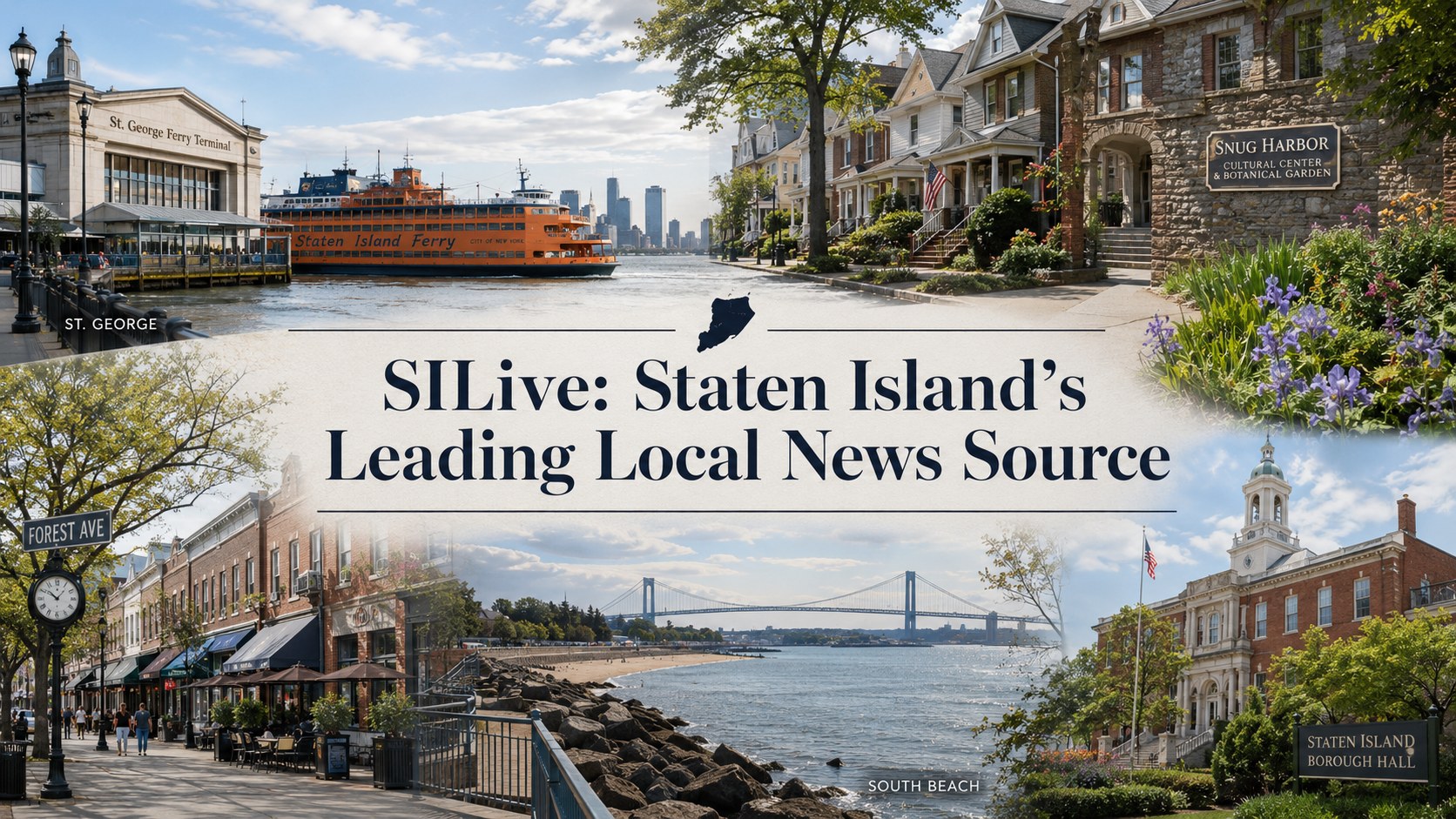

The borough is part of New York City, but it doesn’t always get treated like it by the citywide press. Manhattan gets the cameras. Brooklyn gets the trend pieces. Queens gets the food and transit stories. The Bronx gets crime framing, often too much of it. Staten Island gets noticed when something goes wrong, gets weird, or gets loud.
That’s why SILive matters more than some readers realize.
It’s not perfect. No local news source is. But if you want a steady read on Staten Island schools, traffic, politics, courts, development fights, obituaries, sports, weather alerts, and the small civic arguments that shape daily life, SILive has the home-field advantage. It’s tied to the Staten Island Advance, a newspaper with roots going back to 1886, and that history still matters in a borough where neighborhood memory runs long.
The trick is knowing how to read it. Not blindly. Not angrily. Use it like a local radar.
Why SILive Matters
SILive is one of the most useful starting points for Staten Island news because it covers the borough as a place with its own daily rhythm, not as a side note to Manhattan. You’ll find breaking news, local politics, public safety updates, high school sports, community coverage, obituaries, and stories tied to the Staten Island Advance in one place.
Island News Habits
Staten Island follows news differently from the rest of New York City.
That sounds broad, but it shows up in the way stories travel. A crash on the Staten Island Expressway can matter more to a local reader than a City Hall press conference. A zoning fight near Hylan Boulevard can get more private group-chat attention than a national political speech. A school issue in Tottenville or New Dorp can move through families before the larger city press even notices.
That’s the gap SILive fills.
The borough’s geography makes this even sharper. Staten Island is physically connected to the city, yes, but daily life often feels separated by bridges, ferries, tolls, buses, expressways, and long commutes. A source that understands that is worth more than a big-city outlet that parachutes in after a fire, indictment, viral video, or political dust-up.
I’ve noticed a pattern with Staten Island coverage: outside outlets often frame the borough through stereotypes. Conservative. Suburban. Angry. Forgotten. Those labels can have pieces of truth, but they’re lazy when used as the whole picture. Local coverage has to be more patient than that.
SILive tends to understand the borough’s mixed personality better. It can cover a local fundraiser and a corruption case in the same news cycle. It can write about ferry delays, youth sports, court hearings, restaurant news, storm prep, and the strange little quality-of-life disputes that only make sense if you’ve read Staten Island news for a while.
That range matters.
A local news source doesn’t have to be glamorous. It has to be useful when your morning is already half-broken by traffic.
What Most People Get Wrong
People complain about local news as if it should behave like a public utility: free, instant, perfectly staffed, fully detailed, never wrong, and somehow not supported by ads or subscriptions.
Come on.
The annoying thing about that argument is that the same readers who say they want deeper reporting also get irritated when a local outlet uses a paywall, runs sponsored content, or updates a breaking story in stages. You can’t demand full-time borough coverage and then act shocked that someone has to pay reporters, editors, photographers, developers, and support staff.
SILive catches some of that frustration because it’s visible. It’s the outlet people know. When coverage feels thin, readers blame it. When a headline feels too sharp, readers blame it. When a story doesn’t include the one detail they heard from a neighbor, they blame it.
Some criticism is fair. Local outlets can overuse police language. They can be too quick with crime framing. They can lean on official statements when original reporting would be better. They can publish service stories that feel light. They can also miss neighborhood texture when staffing is stretched.
But the bigger mistake is pretending Staten Island would be better off with no borough-focused source at all.
Look at what disappears when local coverage fades: school board scrutiny, small business openings, court follow-ups, local sports recognition, public notices, civic pressure, and the basic record of what happened. The national press won’t replace that. Citywide outlets won’t replace it either. They have different incentives.
SILive isn’t only competing with other newspapers now. It’s competing with Facebook comments, ring-camera clips, neighborhood rumor pages, half-remembered scanner chatter, and people posting “anyone know what happened?” under blurry photos.
That’s not a news system. That’s a fog machine.
Staten Island Coverage
The best thing about SILive is its beat familiarity. It knows the places readers actually name in conversation: St. George, New Brighton, West Brighton, Port Richmond, Westerleigh, Castleton Corners, New Dorp, Dongan Hills, Great Kills, Eltingville, Annadale, Tottenville, and the long commercial stretch of Hylan Boulevard.
That may sound simple. It isn’t.
A lot of city coverage treats borough geography like decoration. A reporter may know “Staten Island” but not understand how different the North Shore and South Shore can feel in politics, housing stock, commute patterns, and public services. Even within Staten Island, a story about St. George can carry a different set of assumptions than one about Richmond Valley.
SILive has more reason to notice those splits.
That matters in practical coverage. A transit story about the Staten Island Railway isn’t the same as a broad MTA story. A ferry disruption is not a minor inconvenience to someone who built their workday around that crossing. A bridge backup is not background noise if it eats the morning school run. A sanitation issue, road closure, NYPD update, school threat, or storm warning can have a borough-specific impact that looks small from Midtown but huge from Huguenot.
For broader borough context, readers can also follow Staten Island local news coverage from outlets that track how Staten Island fits into the larger New York City news cycle. But a borough-first outlet still has a different job. It has to keep returning to the same streets after the citywide spotlight leaves.
That return is where trust is built.
SILive also benefits from the old Staten Island Advance identity. The Advance has long been associated with borough news, and SILive functions as the digital front door for that reporting. The Staten Island Advance/SILive.com brand describes itself publicly as the newspaper for the borough since 1886, which gives the site a deeper local lineage than many newer digital outlets.
History doesn’t make coverage correct by itself. But it does give readers a reason to expect local memory.
The Three-Word Test
Local. Specific. Useful.
That’s the test I’d use for SILive, and honestly, for any borough news source.
Can it tell you what happened nearby? Can it name the agencies, streets, schools, teams, officials, and neighborhoods involved? Can it help you decide what to do next, even if that only means leaving earlier, checking a school notice, avoiding a route, or reading the next City Council vote more carefully?
SILive is strongest when it passes that test.
A Staten Island reader usually doesn’t need another broad opinion about New York City being expensive, crowded, or politically messy. They need to know which development proposal is moving, what happened at a dangerous intersection, whether a restaurant closed, why police blocked off a street, how a local team performed, what storm warnings mean for the borough, and which public meeting might change a neighborhood.
The tangent here is that Staten Island has always had a funny relationship with attention. Some residents resent being ignored. Some resent being noticed only when the story is embarrassing. Some prefer the quiet until a decision gets made without them in the room. That mix creates a news appetite that’s both skeptical and hungry…but that’s a different article.
SILive works best when it doesn’t chase the citywide mood too hard.
The site’s most valuable role is often plain: record the borough’s daily life before it gets flattened into a stereotype. Small stories do that. So do obituaries, school honors, court updates, local business coverage, and high school sports.
That last one is underrated. Local sports coverage is one of the clearest signs an outlet still cares about community texture. A high school game story may not matter to someone in another borough. It matters to the families, coaches, students, alumni, and neighborhoods attached to it.
Local news is allowed to be small. Small is where people live.
How Smart Readers Use It
SILive is most helpful when you use it as part of a news routine, not as the only thing you read.
Here’s the only checklist you need:
- Start with SILive for Staten Island-specific updates, especially breaking news, weather impacts, courts, schools, traffic, obituaries, and local sports.
- Cross-check major citywide issues with other NYC outlets when the story involves City Hall, the NYPD, MTA policy, housing law, or statewide politics.
- Pay attention to whether a breaking story is based on official statements, eyewitness accounts, court records, or later reporting.
- Read beyond the headline before reacting, especially on crime, school threats, lawsuits, and political stories.
- Watch for follow-up coverage because the first version of a local story rarely has every detail.
- Use social media comments as leads, not proof.
- Save local explainers or meeting coverage when an issue affects your commute, taxes, school zone, property, or neighborhood services.
That sounds basic because it is. But most bad news habits come from skipping these steps.
The biggest mistake is treating every article as final. Local breaking news moves in layers. First comes the alert. Then the agency statement. Then the names, charges, injuries, closures, or corrections. Later, if the story has enough weight, you may get court records, family reaction, political response, or a pattern story.
Readers get mad when the first story doesn’t have the fifth-story detail. Sometimes that anger is earned. Sometimes it’s impatience wearing a fake badge.
I’d also separate SILive’s reporting from its broader content mix. Many local news sites now carry newsletters, shopping content, sports betting posts, sponsored material, entertainment pieces, and partner content. That doesn’t mean the core local journalism has no value. It means you should know what kind of piece you’re reading.
A restaurant opening is not a court story. A promo-code article is not a public safety investigation. A high school sports feature is not a City Hall accountability piece.
Read each one on its own terms.
The Costs Nobody Likes To Discuss
Local news has trade-offs, and SILive is no exception.
The first trade-off is access. Some readers will hit subscription prompts or limits. Others will see ads and complain about load times. A site connected to a larger media company has business needs, and those needs shape the user experience. Nobody loves that part. But the alternative is often fewer reporters and less local coverage.
The second trade-off is speed versus depth. SILive can move quickly on breaking news, but speed often means early stories depend on official sources. That’s a common local news problem. Police, fire officials, prosecutors, agencies, and school administrators can provide the first confirmed details. They also frame the story before residents, defendants, families, advocates, or public records add more context.
That’s why the follow-up matters.
The third trade-off is topic balance. Crime and public safety stories draw clicks. So do weather alerts, traffic messes, restaurant updates, obituaries, viral moments, and sports. Quiet government process stories are harder to sell, even though they may matter more over time. A zoning decision can shape a block for decades. A budget line can affect services long after the loud story fades.
Here’s where I’m mildly strict: readers can’t complain that local outlets cover too much crime and then ignore every planning board, school budget, and public meeting story. Attention teaches newsrooms what survives.
SILive also sits inside the broader Advance Local network. Staten Island Media Group describes the Staten Island Advance and SILive.com as part of Advance Local, alongside local news and information sites in other markets. That structure can bring digital support and distribution strength, but it can also make readers wonder how much decision-making feels local.
That tension is real.
It doesn’t make the coverage useless. It means readers should be alert to what’s deeply reported, what’s syndicated, what’s service content, and what’s built for search.
How SILive Compares
SILive’s real competition isn’t only other publications. It’s the entire way Staten Island residents now get information: citywide outlets, TV stations, newsletters, Facebook groups, X posts, Reddit threads, agency alerts, school emails, and text chains.
That’s a messy mix. Some of it is fast. Some of it is wrong before lunch.
| Source type | What it’s good for | Where it falls short |
|---|---|---|
| SILive / Staten Island Advance | Borough-specific reporting, breaking updates, sports, obituaries, local politics, courts, weather impacts | May mix hard news with lighter content; some stories need follow-ups |
| Citywide NYC outlets | City Hall, NYPD, MTA, housing, courts, major investigations | Staten Island can become a small piece of a bigger story |
| TV news | Visual breaking news, major incidents, quick public alerts | Often brief, episodic, and less useful for neighborhood detail |
| Social media groups | Fast chatter, eyewitness tips, hyperlocal concerns | Rumor spreads quickly; context is often missing |
| Official agency alerts | Closures, safety notices, verified statements | Agencies control the framing and rarely tell the whole story |
The table tells the truth better than a fan argument would. SILive is not always the deepest source on a citywide policy issue. A transit investigation, housing lawsuit, police discipline story, or state budget fight may be stronger elsewhere. But for day-to-day Staten Island awareness, it has a clear lane.
That’s the practical verdict.
Use SILive to understand what’s happening in the borough. Use citywide and specialist outlets to understand the machinery behind bigger issues. Use official alerts for confirmation. Use social media for hints, not conclusions.
The best readers don’t pledge loyalty to one source. They build a stack.
SILive belongs near the top of the Staten Island stack because it tracks the borough with more regularity than outlets built for the whole city. The official SILive site also points readers directly into that local mix, from breaking news to community features and service coverage.
But don’t confuse volume with final truth. A busy local site can publish a lot and still leave questions open. That’s not always failure. Sometimes that’s how local reporting works when a story is still moving.
What Does SILive Cover Best?
SILive is strongest in coverage areas where borough familiarity gives it an edge.
Public safety is one. Staten Island readers often turn to local outlets after crashes, fires, police activity, emergency responses, and court developments. The details matter: the road, the neighborhood, the time, the agency involved, the likely impact on traffic or schools. A citywide outlet may mention “Staten Island.” SILive is more likely to name the slice of Staten Island that actually matters.
Schools are another. Local families care about threats, rankings, sports, closures, student honors, budget changes, and district decisions. Education coverage can get complicated because school stories involve parents, administrators, unions, city agencies, and student privacy. Still, a local source is better positioned to notice recurring anxiety.
Weather and traffic are also natural strengths. Staten Island weather coverage needs to care about coastal flooding, bridge conditions, ferry service, downed trees, and road closures. The borough is not simply “NYC weather.” A storm can hit daily life differently depending on elevation, commute route, shoreline exposure, and transit options.
Obituaries remain a major local function too. Some readers dismiss obituary pages as old media. That’s a mistake. Obituaries are part of the civic record. They tell you who built businesses, served in local groups, coached teams, raised families, taught classes, or became part of neighborhood memory.
Then there’s sports. High school sports coverage gives local students a public record of effort. It also gives communities something better than outrage to gather around.
The weak spot? Larger accountability work is harder. Deep investigations take time, documents, legal review, and staff. Local outlets can do them, but not every week. Readers should value them when they appear and demand more without pretending they cost nothing.
Breaking News Gets Messy
Breaking news is where readers should be both grateful and careful.
SILive can be fast. That’s useful when a road is blocked, a fire is active, a school has issued an alert, or a storm is affecting service. The problem is that speed creates gaps. Early reports may not yet include names, charges, injury severity, cause, motive, agency response, or whether an initial claim holds up.
Is that frustrating? Yes. Is it unique to SILive? No.
The better question is whether the story gets updated as facts become clearer. Good local breaking coverage should show its work. It should say what officials confirmed, what remains unknown, and when details changed. It should avoid making one official sentence carry more certainty than it deserves.
Readers have a job here too. Don’t screenshot the first paragraph and treat it as the permanent record. Don’t turn a rumor into a “report.” Don’t assume a missing detail is being hidden. Sometimes it’s missing because nobody responsible will confirm it yet.
I’ve watched this pattern repeat across local news: the first version gets the most emotional reaction, while the corrected or fuller version gets half the attention. That’s backwards, but it’s how people read when they’re worried.
SILive’s value in breaking news is not that it will know everything first. Nobody does. Its value is that it has reason to keep tracking a Staten Island story after larger outlets have moved on.
That follow-through is the local part.
FAQ
Is SILive the same as the Staten Island Advance?
Yes, SILive is the digital home closely tied to the Staten Island Advance brand. Readers often treat them together because SILive carries digital news coverage connected to the longtime Staten Island newspaper. The Advance name brings the historical weight; SILive is where many readers now meet the coverage.
Does SILive only cover Staten Island?
No, SILive is mainly known for Staten Island coverage, but stories can touch wider New York City issues when they affect the borough. Transit, courts, politics, weather, sports, and public safety often cross borough lines. The Staten Island angle is usually the reason readers go there.
How old is the Staten Island Advance?
1886 is the date most commonly tied to the Staten Island Advance’s founding. That makes it one of the older local newspaper brands connected to New York City borough coverage. Age alone doesn’t prove quality, but it does explain why the name still carries local recognition.
Is SILive good for breaking news?
Often, SILive is useful for breaking Staten Island news because it follows local incidents more closely than many citywide outlets. You should still check updates later. Early breaking stories may rely on official statements and may not include the fuller context until more reporting is available.
Why do some SILive stories have paywalls or ads?
Paywalls and ads help support the business side of local reporting. Honestly, it depends on the article, your access, and the site experience at the time. Readers may dislike it, but steady borough coverage requires money, staff, tools, editors, and time.
Can I trust SILive for local politics?
Trust it as a starting point, not your only source. Local politics coverage can be useful when it tracks candidates, city agencies, council actions, borough issues, and neighborhood disputes. For bigger policy fights, compare SILive with citywide outlets, public records, and official meeting materials.
What does SILive cover besides hard news?
Sports, obituaries, entertainment, weather, traffic, business openings, schools, community stories, opinion, newsletters, and service pieces all show up in the mix. That variety is normal for a local outlet. The smart move is to separate reported news from lighter lifestyle or promotional content.
Is social media faster than SILive?
Sometimes social media is faster, but faster doesn’t mean truer. A neighbor may post about sirens before a reporter confirms anything. That can be useful as an alert, not as proof. SILive’s role is to verify, frame, update, and preserve the record.
Read It With A Sharper Eye
SILive is worth reading because Staten Island needs coverage that starts from Staten Island, not coverage that remembers the borough after something dramatic happens. Its best work is practical, local, and specific: the kind of reporting that helps you understand the day before the rumor mill gets too loud.
Your next step is simple. Pick one local issue you care about — a school, road, ferry problem, development plan, court case, or elected official — and follow it across several SILive stories instead of judging the outlet from one headline. That habit will make you a better reader fast.
Local news isn’t supposed to flatter a borough. It’s supposed to keep it visible, irritated, informed.