
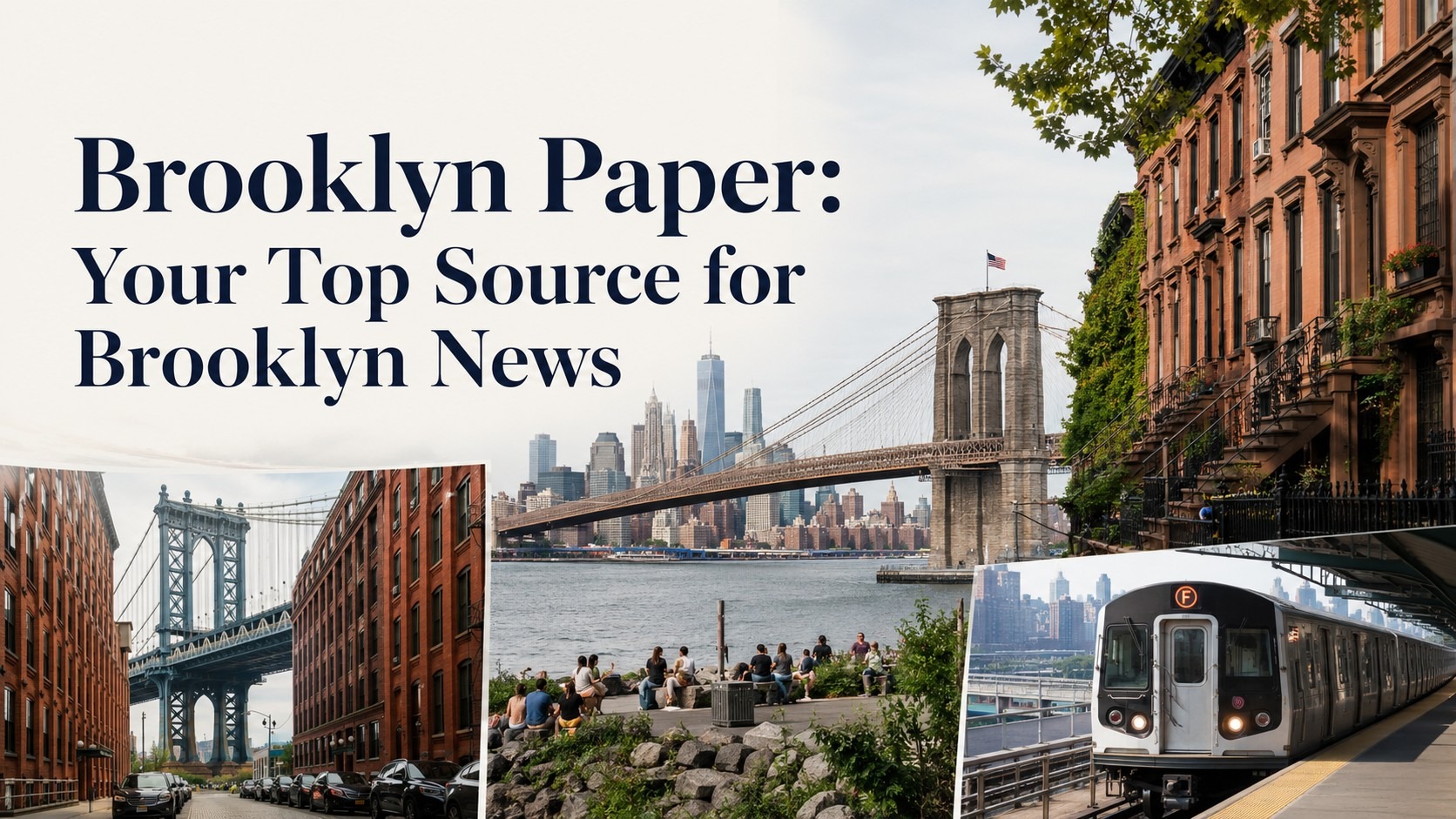

This outlet still matters more than skeptics admit. Brooklyn Paper sits in a strange place now: old enough to carry print-era local-news habits, but current enough to compete for readers who check neighborhood updates on phones between train stops. If you’re searching for Brooklyn news, you’re probably not looking for one more loud headline. You want to know which source actually helps you understand what’s happening on your block, in your school district, near your train line, or around the small businesses you pass every week. Brooklyn has too many moving parts for lazy borough-wide summaries. A good local outlet has to catch the zoning fight, the street safety meeting, the restaurant opening, the police update, the arts calendar, and the small political shift before it becomes a bigger city story. According to Schneps Media, The Brooklyn Paper launched in 1978 and became Brooklyn’s first successful free newspaper, which explains why its identity still leans neighborhood-first rather than city-hall-first.
Why Readers Still Start There
Brooklyn Paper is a practical starting point for Brooklyn news because it focuses on borough-level reporting, neighborhood events, politics, crime, culture, and community updates without forcing readers through a full New York City news firehose. It’s best for people who want Brooklyn-specific coverage first, then wider NYC context after.
Is Brooklyn Paper Still the Right First Stop for Brooklyn News?
The better question isn’t whether Brooklyn Paper is perfect. It isn’t. The better question is whether it gives you a useful first read before you compare details elsewhere.
For a lot of Brooklyn readers, the answer is yes.
Local news is messy because the same story can mean different things in different neighborhoods. A street redesign in Park Slope reads one way to a cyclist, another way to a delivery worker, and another way to a parent trying to cross Fourth Avenue with a stroller. A rezoning story in Gowanus doesn’t land the same as a development story in East New York. Brooklyn Paper tends to understand that the borough is not one audience. That matters.
The publication’s own parent company describes it as Brooklyn’s leading source of news and information, and the brand’s history reaches back to 1978. That long memory gives it a different feel from quick social posts or citywide outlets that parachute into a story once it starts trending.
Here’s the analyst thing I keep noticing: readers often say they want “breaking news,” but what they actually need is follow-through. A shooting update is one kind of story. A follow-up about the precinct meeting, victim services, court process, nearby businesses, and residents’ complaints is another. Brooklyn Paper is most useful when it stays close to that second lane.
You won’t get every angle from one outlet. Nobody does. But if your daily question is “What’s happening in Brooklyn that might actually affect me?” this is one of the first tabs worth opening.
What Makes Local Brooklyn Coverage Different
Brooklyn is not just “New York City, but brownstones.”
That mistake ruins a lot of local coverage. Writers who don’t understand the borough flatten it into clichés: Williamsburg cool, Park Slope parents, Coney Island summer, Brooklyn Heights money, Bed-Stuy change, Bushwick nightlife. Fine. Those are pieces of the borough. They are not the borough.
Good Brooklyn reporting has to move between housing court pressure, school zoning fights, tenant organizing, small-business turnover, MTA service pain, nightlife rules, public safety, immigrant communities, parks, hospitals, beaches, churches, synagogues, mosques, block associations, and council politics. Some of that is glamorous. A lot of it is not. The unglamorous part is usually where the real story lives.
Brooklyn Paper’s value comes from that borough-level attention. It often covers stories that won’t lead a citywide homepage but still matter to residents. A local merchant group arguing about street space might look small from Midtown. In Brooklyn, it can shape how a whole commercial strip functions for years.
And Brooklyn readers are sharp. They can tell when a reporter has done the basic work. Did the story name the neighborhood correctly? Did it confuse a community board with a council district? Did it treat “Brooklyn residents” like one giant opinion blob? Did it mention the subway line people actually use?
Those details sound tiny until they’re wrong. Then they’re not tiny at all.
For wider borough context, it also helps to compare local reporting with broader Brooklyn local news coverage so you can see which stories are isolated and which are part of a bigger New York City pattern.
The Brooklyn News Test
A local outlet earns trust by passing boring tests.
Not dramatic tests. Not glossy ones. Boring ones.
Does it publish often enough that readers don’t feel abandoned? Does it separate neighborhood facts from citywide noise? Does it cover both crime and culture without acting like either one defines the whole borough? Does it name public officials, agencies, streets, parks, and local groups clearly enough that a reader can follow up?
That’s where Brooklyn Paper generally performs better than a casual reader might expect. It has the old community-paper instinct: tell people what happened, where it happened, who is involved, and why the neighborhood should care. You’d think that would be standard. It isn’t.
| What readers need | Where Brooklyn Paper helps | What to double-check |
|---|---|---|
| Neighborhood updates | Strong on borough-specific stories and local events | Whether there’s a later city agency update |
| Crime and public safety news | Useful for incidents, precinct-level concerns, and community reaction | Official NYPD or court details when stakes are high |
| Development and housing coverage | Good for local disputes, projects, and community board friction | City planning documents and permit timelines |
| Arts, food, and events | Strong fit for weekend planning and culture coverage | Venue pages for prices, dates, and cancellations |
| Political coverage | Helpful for borough officials and local races | Campaign filings, council records, and Board of Elections data |
The trade-off is obvious. A local outlet can be close to the ground, but it may not always have the staff size or document depth of a larger newsroom. A citywide outlet can bring more legal, data, or investigative muscle, but it may miss the block-level feeling of the story.
Smart readers don’t choose one forever. They build a small news diet.
Start with Brooklyn Paper. Check a citywide outlet. Then, if the issue affects your rent, school, commute, safety, or business, look for the primary document. That might be a community board agenda, a Department of Buildings filing, a court record, an MTA notice, or a city press release. Annoying? Yes. But that’s how you avoid becoming the person loudly wrong in the group chat.
What Most People Get Wrong About Borough News
People keep treating local news like it’s only useful when something bad happens.
That’s lazy, and honestly, it’s how neighborhoods lose track of themselves.
Crime coverage gets attention because it’s immediate. Fires, crashes, arrests, assaults, and police searches have urgency. Readers should know about those stories. But if that’s all you read, your view of Brooklyn gets warped fast. You miss school debates before they become parent outrage. You miss small business closures until the storefront is empty. You miss a rezoning meeting until the scaffolding goes up. You miss park upgrades until the ribbon-cutting photo appears.
A good Brooklyn news source should do more than tell you what scared people yesterday. It should tell you what’s changing slowly.
That’s where neighborhood papers still have a role. They notice patterns that social media often turns into fragments. A few complaints about trash pickup become a sanitation story. A long permit delay becomes a small-business survival story. A noisy nightlife dispute becomes a question about housing, policing, tourism, and who gets to sleep.
Look, the comment-section version of Brooklyn is usually louder than the real one. People talk as if every issue has two sides, both furious. On the ground, many stories have five sides, three side conversations, and one exhausted person asking why the city agency didn’t answer the phone.
Brooklyn Paper is strongest when it captures that texture. Not always perfectly. But often enough to make it worth reading before the takes arrive.
How to Read Brooklyn Paper Without Missing the Bigger Story
The trick is not to read it like a final verdict.
Read it like a strong first briefing.
Here’s a simple way to use it without getting trapped in one outlet’s frame:
- Start with the headline and neighborhood, then ask whether the story is about one incident, a trend, or a policy fight.
- Check who is quoted and who is not quoted, because missing voices often reveal the next story.
- Look for named agencies, elected officials, community boards, police precincts, schools, businesses, or nonprofits.
- Compare the story with at least one citywide or official source when money, safety, housing, or legal claims are involved.
- Save the follow-up angle: meeting date, court date, vote, hearing, opening, closure, deadline, or promised agency response.
That last step is where most casual readers fall off. They read the first story, react, and never check what happened next.
For example, a Brooklyn Paper piece about a proposed street redesign may give you resident reactions, local business concerns, and political pressure. That’s useful. But the next layer might sit in a DOT presentation or a community board transportation committee meeting. A story about a new restaurant can help you decide where to go this weekend, but the venue’s own page is where you check hours. A crime story can tell you what police reported, but court and official updates may shift the picture later.
No outlet should be treated like a courthouse, city agency, event calendar, and neighborhood historian all at once. That’s too much weight for any newsroom.
The useful habit is simple: read fast, compare slowly.
The Paper’s Old-School Strength Has a Modern Problem
Brooklyn Paper comes from a community newspaper tradition, and that’s both its advantage and its headache.
The advantage is trust through repetition. A brand that has covered Brooklyn for decades carries name recognition. Schneps Media says its local brands have been trusted sources for neighborhood news, events, and information for more than 100 years across the company’s broader portfolio. Readers may not think about media ownership every morning, but they do recognize familiar mastheads.
The headache is that readers now expect everything at once. They want speed, depth, clean mobile pages, sharp photos, updates, newsletters, social posts, event listings, and comments that don’t make them regret being literate. They also don’t want to pay much, if anything.
That math is brutal.
Local news has always depended on a strange bargain between readers, advertisers, civic groups, and reporters who know more acronyms than any normal person should. Community boards, BIDs, NYPD precinct councils, school districts, tenant groups, nonprofits, elected offices: each has its own language. The reporter has to translate it without sanding off the conflict.
This is where I’ll take the promised tangent: Brooklyn’s neighborhoods also have a habit of turning tiny symbols into full civic arguments. A painted curb, a new cafe sign, a removed bench, a changed bus stop. Suddenly everyone is discussing class, safety, memory, and who “really” belongs there. That’s probably why local coverage here can feel dramatic even when the item is small…but that’s a different article.
The modern problem is attention. Brooklyn Paper has to compete not only with other newsrooms, but with Instagram posts, TikTok clips, WhatsApp forwards, Reddit threads, and neighborhood Facebook groups that publish rumors at the speed of thumb panic. A newspaper can’t win by being louder. It has to be steadier.
Where Brooklyn Paper Beats Bigger NYC Outlets
Big outlets often arrive when a Brooklyn story has already become impossible to ignore.
That’s not an insult. It’s the nature of big-city newsrooms. They have to cover City Hall, Albany, courts, transit, crime, weather, housing, schools, national politics, and the latest mayoral mess before lunch. They can’t treat every Brooklyn merchant dispute or community board fight as a main event.
Brooklyn Paper can.
Its edge is not always depth. Sometimes its edge is presence. It can publish the story that tells readers a local nonprofit got funding, a neighborhood event returned, a business opened, a council member took a position, a park project moved, or a resident campaign gained traction. None of that may shake the city. Some of it still matters.
A realistic scenario: say a beloved Bay Ridge storefront closes after a long rent fight. A citywide outlet might ignore it unless the owner is famous or the trend is obvious. Brooklyn Paper is more likely to treat the closure as neighborhood news by itself. That gives residents a record. Later, if five more shops close and a commercial rent story emerges, those early items become breadcrumbs.
Another example: a cultural event in Flatbush or Sunset Park may not get citywide attention unless it has celebrity pull. A borough outlet can still tell readers what’s happening, who organized it, and why it matters locally. That kind of coverage doesn’t always win awards. It does build civic memory.
And yes, civic memory sounds grand for a website article. But lose enough small records and a neighborhood starts depending on vibes. Vibes are terrible archives.
Brooklyn Paper’s official site, Brooklyn Paper, is most useful when you want that borough-first feed before you widen the lens.
The Downsides Nobody Should Ignore
Brooklyn Paper is useful, but you shouldn’t treat it like the only Brooklyn source you need.
First, local outlets work under resource limits. That can affect how many stories get follow-ups, how much document work appears in a piece, and how often reporters can revisit slow civic problems. A newsroom can care about a story and still not have enough hours to chase every loose end.
Second, community coverage can lean toward what is reachable. Groups that send press releases, answer calls, hold public events, or know how to talk to reporters often get more coverage than quieter residents. That’s not unique to Brooklyn Paper. It’s a local-news problem everywhere. The squeaky wheel doesn’t just get grease. Sometimes it gets three paragraphs and a photo.
Third, local outlets can face a tricky balance with advertisers, events, community partners, and political relationships. That doesn’t mean coverage is bought or soft. It means readers should stay awake. If a story involves real estate, nightlife, policing, schools, or local elections, compare it with another source.
The biggest downside, though, is reader behavior. People skim a headline, assume they know the angle, and then argue from the headline as if it were sworn testimony. Don’t do that. Brooklyn is too complicated for headline-only citizenship.
There’s also the issue of changing details. Event dates change. Restaurants alter hours. Police investigations shift. Development timelines slip. Public meetings get postponed. If a Brooklyn Paper article helps you make a decision that costs money or time, check the live source before acting.
That’s not distrust. That’s being an adult with a MetroCard and limited patience.
How It Compares With Other Brooklyn News Sources
Brooklyn has more than one useful news voice, and that’s good.
Brooklyn Eagle has a long legacy and often feels stronger in civic, legal, history, real estate, and institutional coverage. BK Reader has a community-centered voice and pays attention to neighborhoods and perspectives that broader outlets can miss. Patch can be useful for quick local items, though quality can vary by market. Citywide outlets like Gothamist, THE CITY, NY1, Daily News, and the New York Post may bring more scale when a Brooklyn story becomes a city story.
Brooklyn Paper’s lane is different. It sits closer to the weekly community-news tradition, with a digital rhythm layered on top. It’s not trying to be every outlet. That’s the right instinct.
The pattern I’ve noticed is that readers get frustrated when they expect the wrong outlet to do the wrong job. Don’t expect Brooklyn Paper to replace a city database. Don’t expect a citywide outlet to care about every block-level dispute. Don’t expect social media to separate confirmed fact from neighborhood steam.
Use each source for its strength.
For a housing fight, start with the local story, then check city planning or housing records. For a public safety issue, read the neighborhood account, then look for official updates and community response. For a weekend plan, Brooklyn Paper may be enough, but the venue page still wins on final details. For politics, read the local piece, then check campaign money, voting records, and public meeting clips if the issue matters to you.
Nobody likes homework. But Brooklyn punishes lazy reading.
Trust Takes Work
Trust in local news is not a feeling you get once and keep forever.
It’s earned story by story.
A Brooklyn news outlet earns it by correcting mistakes, naming sources clearly, avoiding neighborhood stereotypes, following up after the first burst of attention, and treating residents like people rather than quote machines. Readers earn their side of trust by reading past the headline, noticing dates, checking whether a story is news or opinion, and not demanding that every article confirm what they already believed.
This is where Brooklyn Paper’s long history helps, but doesn’t solve everything. The brand has roots. It has recognition. It has a borough identity. Those are advantages. They are not blank checks.
A useful local source should make you feel better informed, not merely more irritated. If you leave every story angrier but not clearer, something is wrong. Sometimes the outlet failed. Sometimes the reader wanted a fight more than information. Usually it’s a little of both.
The best use of Brooklyn Paper is as a regular check-in. Read it for the borough pulse. Notice recurring names and agencies. Watch which neighborhoods get attention and which don’t. Pay attention when a story moves from “local dispute” to “city policy.” That shift is where small news becomes big news.
And keep a tiny bit of skepticism handy. Not the performative kind. The useful kind.
FAQ
Is Brooklyn Paper a real newspaper?
Yes, Brooklyn Paper is a real Brooklyn-focused news publication with roots in the borough’s community newspaper tradition. Schneps Media says The Brooklyn Paper launched in 1978 and became Brooklyn’s first successful free newspaper, which gives the brand a long local history.
Is Brooklyn Paper only about Brooklyn?
No, it’s not only narrow block-by-block coverage, but Brooklyn is the core focus. Stories may connect to wider New York City issues like housing, policing, transit, politics, and culture, yet the angle usually starts with how the matter affects Brooklyn readers.
How often should I check Brooklyn local news?
Three times a week is enough for most casual readers. Check more often during elections, major storms, transit disruptions, public safety alerts, school changes, or neighborhood development fights. Local stories can move quickly when agencies, courts, or community boards get involved.
Can I rely on Brooklyn Paper for crime news?
Honestly, it depends on what you need. Brooklyn Paper can be useful for incident coverage and community reaction, but serious public safety stories should be checked against NYPD updates, court records, citywide reporting, or official statements when details affect your decisions.
What kind of stories does Brooklyn Paper cover?
Brooklyn Paper commonly covers neighborhood news, local politics, crime, small businesses, events, arts, culture, development, community groups, and public issues across the borough. Its strongest role is giving readers a Brooklyn-first read before larger outlets frame the story citywide.
Is Brooklyn Paper better than Brooklyn Eagle?
Better depends on the job. Brooklyn Paper often works well for neighborhood updates and general borough news, while Brooklyn Eagle can be stronger for civic, legal, historical, and institutional coverage. Smart readers use both instead of turning local news into a team sport.
Why do Brooklyn news outlets cover so many small stories?
Small stories often become big issues later. A shop closure, street redesign, school meeting, permit delay, or community board vote can signal larger changes in rent, safety, traffic, development, or neighborhood identity. Dismissing small coverage is a common mistake.
Where should new Brooklyn residents get local updates?
New residents should mix Brooklyn Paper with citywide outlets, official agency pages, community board calendars, local newsletters, and neighborhood groups. One source won’t explain the borough by itself. The fastest learning curve comes from comparing what each source notices and misses.
The Brooklyn Reader’s Best Move
Few boroughs punish shallow reading faster than Brooklyn. The loudest version of a story is rarely the most useful one, and the citywide version often arrives after the neighborhood version has already done the early work. Brooklyn Paper deserves a spot in your regular news routine because it keeps the borough in focus without pretending Brooklyn is simple. Read it first when you want local texture. Then compare, verify, and follow the loose thread that matters to your block, commute, school, business, or weekend plans. Your concrete next step is easy: open the site once this week and pick one story outside your own neighborhood. That’s how you start seeing Brooklyn as a connected place, not just a collection of familiar corners.