
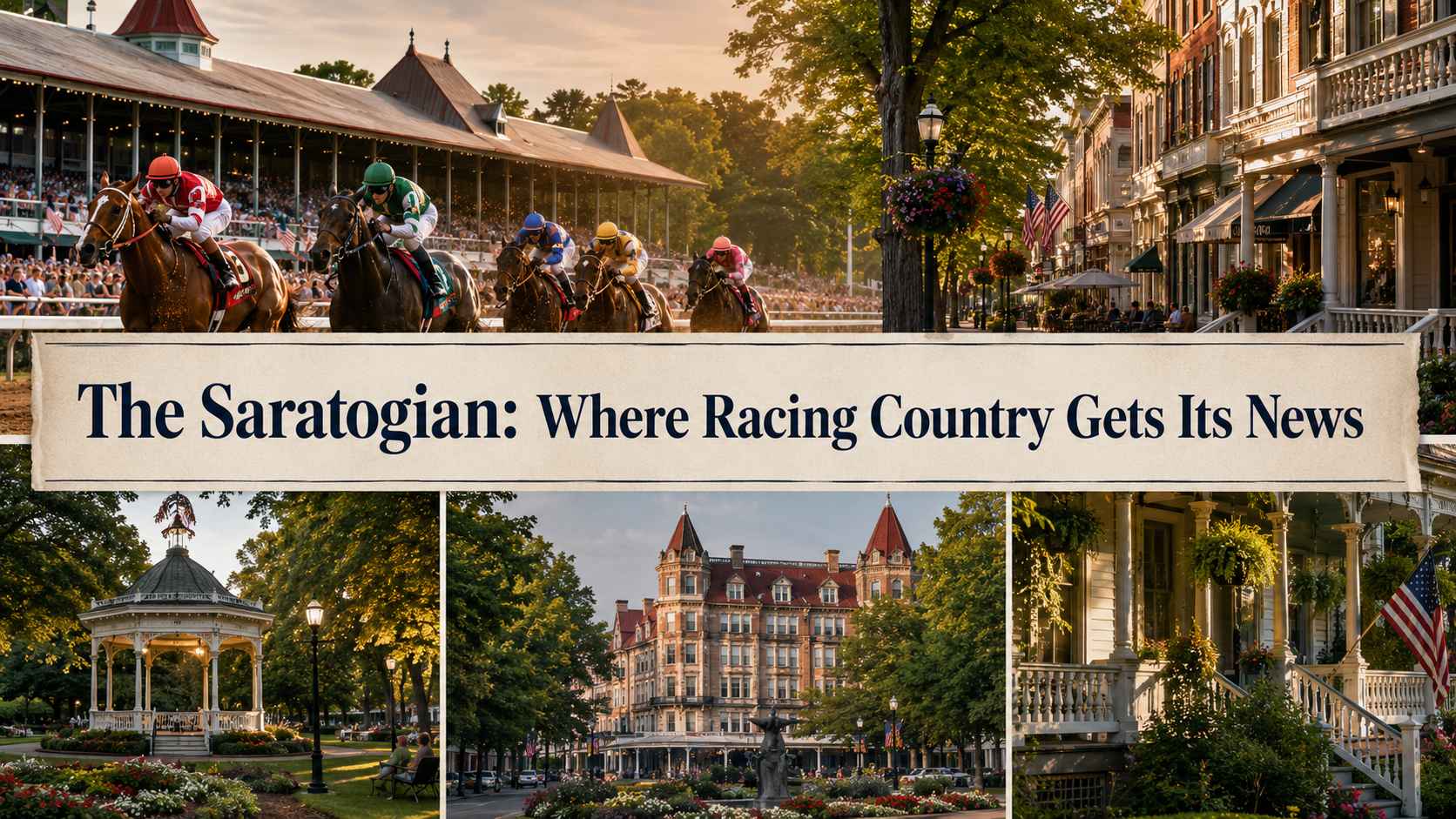

Racing gives The Saratogian its identity, but accountability gives it value. Saratoga Springs may be famous for thoroughbreds, summer crowds, mineral springs, and grand old traditions, yet the people who live across Saratoga County need something less glamorous every day: reliable information about schools, roads, public safety, local government, business, sports, and the decisions that quietly shape their neighborhoods. That is the job a hometown paper is supposed to do.
The paper sits in an unusual market. Its home city is both a year-round community and a seasonal national attraction. News can shift from a city council dispute to a major racing story, then to a school budget, a concert, a court case, or a storm warning without much warning. A publication that understands only the tourist version of Saratoga will miss the place itself. A publication that ignores racing will miss a huge part of its public life.
That tension explains why The Saratogian still matters. You don’t read it only to learn what happened. You read it to understand which local events deserve attention after the summer visitors leave.
The Direct Answer
The Saratogian is Saratoga Springs’ long-running local newspaper, covering community news, government, public safety, business, sports, events, and horse racing across Saratoga County. Its racing coverage gives the paper a distinctive identity, while its everyday reporting helps residents follow the decisions and changes that affect life beyond the track.
Why Does The Saratogian Still Matter?
A local newspaper earns its place differently from a national outlet. It usually can’t win by publishing the fastest national headline, the loudest opinion, or the broadest political analysis. You already have endless places to find those. Its advantage is proximity: knowing which meeting matters, which road closure will snarl a commute, why a school proposal has parents arguing, and how a county decision could land on a household months later.
The Saratogian describes its purpose in similarly local terms. Its public-facing description emphasizes news and sports coverage for Saratoga Springs and surrounding communities, while Discover Saratoga calls it the hometown newspaper for year-round residents. That distinction matters. “Year-round” points to the audience that still needs reporting in January, March, and November.
You can see the value most clearly when a story is too small for statewide media but too important for the people affected. A zoning change near a residential area may never draw a television crew. A school board vote might not travel beyond county lines. A new apartment proposal, police policy, water issue, tax discussion, or hospital expansion can still alter daily life. Local journalism gives those subjects a public record.
I’ve noticed that readers often judge a community paper by the stories they happen to like. That is too narrow. The stronger test is whether the paper regularly covers matters readers might otherwise never know to ask about. Useful reporting expands your attention. It tells you that a planning board agenda, a county contract, or a state funding decision deserves five minutes before it becomes a surprise.
The paper’s sports role works the same way. Racing may be the marquee attraction, but high school teams, college athletics, and local competitors build a different kind of loyalty. Those stories become family history. A clipped result, a championship photo, or a graduation-season profile can matter more to a household than a national sports column written for millions.
No local newsroom covers everything. That fantasy helps nobody. Sometimes the missing item is a two-hour town board meeting with six people in the room.
A Newspaper That Grew Up With Saratoga
Few American communities have changed while keeping their public identity as visibly tied to history as Saratoga Springs. The newspaper’s own lifespan reflects that long arc. The Saratogian traces its daily publication history to 1855, first under the name The Daily Saratogian and later as The Saratogian beginning in 1910. A paper that old has reported through changes in transportation, tourism, government, commerce, wars, population, technology, and the economics of publishing itself.
Longevity alone isn’t proof of quality. Old institutions can become timid, thin, or detached. But age does create something newer outlets cannot instantly copy: accumulated local context. Names recur. Development debates echo earlier fights. Families, businesses, public agencies, and civic groups leave trails that make current events easier to interpret.
The historical advantage is not simply an archive full of yellowed pages. It is the ability to connect a present argument with earlier promises. Suppose a major redevelopment is sold as a fresh beginning. Past coverage may show that the same site has carried several ambitious plans, each with different financing, traffic claims, or public benefits. A reporter who can find that history asks better questions.
| Era | What readers mainly expected | What the paper had to provide |
|---|---|---|
| 1855 to 1909 | Timely local notices, civic affairs, commerce, politics, and community events | A dependable daily record in a growing resort and racing center |
| 1910 through the late 20th century | Broader local reporting, photographs, sports, advertising, public notices, and regional news | A shared printed account of community life delivered on a regular schedule |
| The digital era | Immediate updates, searchable stories, mobile access, breaking news, and deeper context | Speed without losing local knowledge, accuracy, or institutional memory |
The table shows a bigger shift than print versus screens. Earlier readers often encountered the paper as a package (even when they bought it for one story). They saw stories they had not searched for. Digital readers are more likely to arrive through a social post, search result, alert, or shared link. That makes each article easier to find but the whole community harder to see.
This is one of the patterns that concerns me most in local news. When people read only isolated stories, they can remain informed about a controversy while missing the routine coverage that explains how the town works. The dramatic zoning fight appears in a feed. The months of committee discussion that led to it do not. The arrest headline circulates. The later court outcome may pass quietly.
A longstanding paper also carries the burden of expectation. Readers remember what it used to cover, how thick it used to be, who wrote a beloved column, or which local event once received a full page. Nostalgia can become unfair because the economics have changed. Still, that memory is useful pressure. It tells publishers that local identity is not a decorative brand element. People notice when it thins.
Old front pages still show how ordinary announcements eventually become history.
Racing Is the Hook, Not the Whole Story
Horse racing gives Saratoga a rhythm that few small cities share. The summer meet changes traffic, restaurant demand, hotel occupancy, social calendars, employment, policing, tourism, and the public mood (the practical part visitors often miss). The official 2026 Saratoga Race Course schedule, for example, runs live racing through Labor Day, though specific dates and event details can change from year to year. For a hometown newsroom, racing is not a niche sports beat. It touches nearly every major local beat at once.
The Saratogian’s historical association with the Pinksheet captures that identity. The summer publication has been tied to same-day information about Saratoga Race Course activity, giving readers a practical racing companion rather than only a recap after the horses have run. That kind of product makes sense in Saratoga because the track is not distant entertainment. It is part of the city’s operating system.
The track creates news far beyond results
A shallow racing story tells you who won. A stronger local story explains what the meet means around the result.
Think about the questions residents and visitors actually ask. How will attendance affect parking? Which roads will be crowded? What events are scheduled around town? How are local businesses preparing? What public safety concerns come with larger crowds? Which trainers, jockeys, owners, and horses are shaping the meet? What does a major racing development mean for Saratoga’s national profile?
Those questions pull together sports reporting, business coverage, transportation, hospitality, public policy, and culture. They also create a temptation: letting the spectacle consume the newsroom. Racing stories are visually appealing and widely shareable. They can attract readers from outside the county. A detailed article about a municipal budget line rarely has that advantage.
But the hometown audience lives with the consequences after the headline fades. A restaurant owner may care about visitor volume. A worker may care about seasonal employment. A family may care about getting across town. A nearby resident may care about noise, parking, or late-night activity. The racing economy looks different depending on where you stand.
The best coverage keeps two audiences in view
Visitors often want schedules, features, personalities, results, and the flavor of Saratoga. Residents want those things too, but they also need the practical story underneath. The smart editorial move is not choosing one audience. It is writing with enough local depth that both understand more.
The paper’s official news website naturally becomes busiest and most visible when major events are moving quickly. Yet its real credibility is built before and after those spikes, when reporters follow public decisions that do not arrive with a grandstand crowd.
I’ve watched local publications in tourism-heavy communities make the same mistake: they slowly begin writing about the place as though everyone is visiting it. Restaurant openings replace government scrutiny. Event previews crowd out follow-ups. The city becomes a product. That approach may perform well for a while, but residents eventually sense that their home has been reduced to a brochure.
The unglamorous story might be the parking plan published two days before the first big crowd.
What Year-Round Coverage Actually Has to Do
Local reporting becomes valuable through repetition (a glamorous phrase it is not). One city council meeting rarely explains a policy. One school board story rarely captures a district’s direction. One police release rarely reveals a public-safety trend. The work gains meaning when a newsroom returns, compares, checks, and follows up.
That sounds ordinary. It is not. Follow-up reporting is among the first things readers miss when newsroom capacity shrinks because new headlines always compete with unfinished stories. A proposal is announced, but what happened six months later? Officials promise a study, but was it released? A business project receives approval, but did construction begin? A lawsuit is filed, but how was it resolved?
The most useful Saratoga County local news coverage should help readers see those threads across communities rather than treating each event as a separate burst. Saratoga Springs is the county’s best-known city, but county life also includes places with different concerns, growth patterns, school systems, tax bases, and transportation needs. A reader in Clifton Park may not prioritize the same issues as someone in Ballston Spa, Wilton, Malta, Mechanicville, or a rural town farther north.
Good county coverage respects those differences without turning every place into an isolated island. A major employer affects more than one municipality. Housing pressure crosses borders. Traffic, emergency services, water, development, and school enrollment do not stop at a welcome sign.
Local business reporting deserves special care in Saratoga because seasonal attention can distort the picture. A crowded summer sidewalk may suggest universal prosperity while year-round costs tell another story. Retailers, restaurants, arts groups, contractors, health providers, and service businesses all operate on different cycles. The useful article asks who benefits, who struggles, and what conditions may last.
Public-safety coverage also demands judgment. Posting every police release creates volume, not necessarily understanding. Readers need verified facts, proportion, and later updates. Arrests are allegations, not convictions. Court outcomes matter. So do patterns that individual incident stories cannot show.
Look, nobody expects a local paper to publish a dissertation on each meeting. Readers do expect it to identify stakes. Why is the board voting? Who pays? What changes? Who objected, and on what grounds? What happens next?
A meeting date buried in the final paragraph can be more useful than the quote in the headline.
The Audience Changed Before the Mission Did
Readers no longer approach a newspaper from one front door. Some type the site address. Others arrive through search, newsletters, phone alerts, Facebook, shared texts, or a link dropped into a neighborhood group. The same article may be read by a longtime subscriber, a visitor planning a weekend, a former resident living across the country, and someone who has never heard of the paper.
Distribution changed faster than local habits (sometimes before breakfast). People still want to know why a siren sounded, when a road will reopen, what the school decided, and why taxes may rise. They simply expect the answer to find them.
That expectation has a cost. Social platforms reward urgency, emotion, conflict, and clean villains. Municipal reporting is often slow, procedural, and stubbornly complicated. A three-hour meeting may produce one important vote and several details that matter later. Compressing that into a post without flattening it is skilled work.
I’ve noticed another shift: readers increasingly confuse access with coverage. A neighborhood group can provide dozens of comments within minutes, but comments are not reporting. They may contain useful eyewitness information, rumors, old grievances, political campaigning, or a perfectly confident mistake. The speed feels satisfying. Verification takes longer.
The ideal relationship is not newspaper versus community discussion. It is reporting feeding better discussion. A solid article gives people shared facts before they argue about meaning.
And yes, local Facebook debates can become a separate civic theater, complete with recurring characters and grudges that outlive the original issue—but that’s a different article.
Tomorrow’s reader may arrive from a text message rather than a front page.
What Most People Get Wrong About Small-City Newspapers
Bad advice about local news usually starts with a lazy assumption: if a story is not dramatic, it is not important. That idea has done real damage. It trains readers to ignore the slow machinery of government until a tax bill, development project, school change, or public controversy lands directly in front of them.
A planning board meeting can be dull and consequential at the same time (yes, even the boring packet). Those qualities are not opposites. The same is true of budget hearings, procurement decisions, environmental reviews, labor agreements, and infrastructure plans. Democracy contains paperwork. Pretending otherwise turns civic coverage into entertainment.
“Small” news is often early news
A short article about a proposed project may be the first public signal of a much larger change. By the time construction equipment arrives, the meaningful public-comment period could be over. The resident who says, “Why didn’t anyone tell us?” may have missed three notices, two meetings, and several stories because none looked urgent in isolation.
This is where local papers should be mildly repetitive. Readers do not follow every beat every day. Important proposals need context each time they advance. Repeating the basic facts is not padding when months pass between votes.
The opposite error is covering only controversy. Conflict attracts attention, so a newsroom may focus on the loudest opponents and supporters while neglecting the actual document under debate. Who read the proposal? What does it say? Which claims are supported? What remains unknown?
You would be surprised how often public arguments run ahead of the available facts.
A hometown paper is not a town cheerleader
Another misconception is that local journalism should protect the community’s image. That sounds friendly until scrutiny becomes inconvenient.
A paper can celebrate local achievements, profile volunteers, cover festivals, and support civic pride without acting as a public-relations department. In fact, honest reporting is a form of respect. It assumes residents can handle uncomfortable facts about officials, institutions, development, crime, finances, or inequality.
The reverse is also true. Relentless negativity is not proof of toughness. If every local institution is framed as corrupt, failing, or foolish, coverage becomes another distortion. Most communities contain competent people, messy systems, good intentions, personal rivalries, weak decisions, and occasional misconduct all at once.
My rule when evaluating local reporting is simple: look for evidence of independence in both directions. Does the publication question powerful institutions? Does it also resist turning every disagreement into scandal? Can it correct an error clearly? Does it separate reporting from opinion?
Readers sometimes demand “unbiased news” when they actually mean “news that does not irritate me.” A credible local paper will irritate nearly everyone occasionally. The reason should be the facts, not cheap provocation.
A correction box at the bottom of a story may tell you more about a newsroom than its loudest editorial.
A Better Way to Read Local News
Treat local news as a habit, not an emergency service (five minutes is enough). If you visit only when a scandal breaks, you will understand the personalities but miss the process. A few minutes several times a week can give you more civic awareness than hours of angry catch-up after a decision is final.
The goal is not to read every article. Nobody does. The goal is to build a simple filter that catches issues before they become personal surprises.
- Start with the local homepage, not only social feeds. Social algorithms show what gets reaction. A homepage shows what editors believe is worth placing together, including quieter stories that may affect you later.
- Follow two or three recurring beats. Choose the areas closest to your life, such as city government, schools, public safety, business, development, or racing. Regular reading helps you recognize names, timelines, and unresolved questions.
- Open meeting stories before controversy peaks. Early coverage often contains the dates, documents, and public-comment details you need to participate. Waiting for outrage usually means entering late.
- Separate reported facts from quoted claims. A source saying something in an article does not make the statement proven. Notice what the reporter confirms, what remains an allegation, and which side has not responded.
- Check the date and look for follow-ups. Local stories can circulate again months later, especially on social media. Search the publication for newer coverage before assuming the first article is the final word.
- Read beyond your own municipality once a week. Countywide growth, state funding, major employers, health care, transportation, and regional development often connect communities that seem separate.
- Support the work you repeatedly use. That may mean subscribing, signing up for a newsletter, sharing original links, sending a useful tip, or correcting misinformation by pointing people to verified reporting.
The fifth step is more important than it looks. Old stories often return without context because the headline still feels current. A proposal may have been changed, rejected, approved, delayed, or completed. The original article becomes a snapshot mistaken for a live camera.
I also recommend reading one story outside your usual interests. Sports readers should sometimes open a government article. Political readers should occasionally read arts, education, business, or community features. A town is not a single argument.
The article you nearly skip may contain the vote scheduled for next Tuesday.
Preserving Local Memory
Subscriptions are part of the bargain, and the bargain can feel awkward. Readers are used to free information online, yet reporting costs money: salaries, editing, photography, technology, legal review, public-record requests, travel, insurance, and time. Local advertising once carried more of that burden. Digital competition scattered the revenue while leaving the reporting need in place.
Prices and promotional offers change, so quoting a fixed subscription figure would age badly. The practical question is whether the access matches how often you use the reporting. A daily reader may see obvious value. An occasional visitor may hit a paywall before trust has formed. Publishers have to balance conversion with discovery, and they do not always get it right.
The public-interest trade-off becomes sharper during emergencies. Severe weather updates, election results, safety alerts, and urgent civic notices may have value far beyond the subscriber base. Some publishers make selected stories free, while others rely on article limits or temporary access rules. Readers rarely understand the policy until they meet it.
The Saratogian has passed through larger newspaper ownership structures and is associated with the MediaNews/Digital First network; MediaNews Group itself is owned by Alden Global Capital. Alden’s newspaper strategy has drawn sustained criticism over cost cutting, including from journalists and industry observers, while the company continues to operate a large collection of local publications.
Ownership matters because it can influence staffing, printing, technology, shared content, editorial policy, and the time reporters have. But it should not become a shortcut for judging every article. The fairest questions are specific: Are city meetings covered consistently? Do local bylines appear often? Are corrections visible? Are stories updated? Is there original reporting, or mostly rewritten announcements?
Readers feel the trade-offs in smaller ways too. A newspaper site may carry heavy advertising, subscription prompts, or slow-loading pages. A lean staff may have to choose between a county meeting, a breaking fire, a school event, and a late sports game. Shared regional stories can add breadth, but too much shared content makes a local brand feel generic.
The deeper cost appears in the archive (and somebody has to maintain it). Communities constantly rewrite their own stories. A delayed project becomes “new.” An old dispute is called unprecedented. Officials take credit for ideas that began years earlier. Without a searchable record, confidence can replace accuracy.
A local archive preserves names, votes, promises, dates, obituaries, business openings, championships, disasters, celebrations, and ordinary notices that become important later. A family may find a relative who coached a team, ran a store, served on a board, or appeared in a community photograph. A resident can compare a current development promise with what officials said years before.
I’ve found that people praise archives in theory but consume news as if only today matters. Searchable access helps, yet archives can be incomplete, poorly indexed, or locked behind separate systems. Preservation needs money and attention too.
Racing history naturally occupies a large space in Saratoga’s public memory. It should. But racing country also contains classrooms, courtrooms, farms, subdivisions, firehouses, stages, storefronts, hospitals, town halls, and kitchen-table arguments about what should happen next.
Frequently Asked Questions
Is The Saratogian only focused on horse racing?
No, horse racing is a signature part of its identity, but the paper also covers local government, public safety, schools, business, community events, sports, and regional issues. Racing becomes especially prominent during the Saratoga meet because it affects the area’s economy, traffic, tourism, and culture.
Does The Saratogian cover all of Saratoga County?
Yes, its traditional coverage area extends beyond Saratoga Springs into surrounding Saratoga County communities. The amount of reporting from each municipality can vary with staffing, news value, and major events, so readers may see heavier coverage of the city and larger population centers.
How old is The Saratogian newspaper?
1855 marks the beginning of its daily publication history. It was first known as The Daily Saratogian and adopted The Saratogian name in the early twentieth century. That long record makes it one of the community’s enduring sources for local history and civic information.
Can I read The Saratogian online without a subscription?
Honestly, it depends. Access rules, free-article limits, promotions, and subscription offers can change. Some stories may be available without payment, while frequent readers may encounter a paywall. Check the publication’s current terms rather than relying on an older price or access policy.
Is The Saratogian a locally owned newspaper?
Not in the traditional independent sense. The paper is part of a larger newspaper ownership network connected with MediaNews Group and Digital First Media. Local journalists can still produce original community reporting, but corporate ownership may shape staffing, technology, printing, shared content, and business decisions.
What is the Saratogian Pinksheet?
The Pinksheet is associated with the paper’s summer racing tradition and has provided day-of-racing information connected to Saratoga Race Course. It reflects the unusually close relationship between the newspaper, the track, and readers who follow the Saratoga meet each summer.
Why should residents pay for local news when social media is free?
Free posts can spread information quickly, but they do not consistently provide verification, public-record work, meeting coverage, editing, corrections, or long-term archives. A subscription supports the labor behind original reporting. Social discussion is useful; it is not a dependable replacement for accountable journalism.
The Real Test Is Tomorrow
Trust is not earned by age, a famous masthead, or a crowded racing calendar. It is earned story by story, especially when the subject is technical, unpopular, or easy to ignore. The Saratogian’s next chapter will depend on how well it protects that local purpose while adapting to changing habits, ownership pressures, and the difficult economics of news.
Your concrete next step is simple: open one local government or school story today, then follow the issue until the next vote or update. Do not wait for a controversy to make the subject interesting.
Racing will always give Saratoga drama, color, and national attention. The sharper measure of a hometown paper is what it records on an ordinary weekday, when no grandstand is roaring and the community still needs someone paying attention.